
 فارسی
فارسی
 english

Living, working, or studying in Turkey often comes with the challenge of managing finances across borders. Due to strict banking sanctions, you cannot simply use a standard wire transfer to move funds back home. However, this does not mean it is impossible. Secure, instant, and fully legal solutions exist that bypass these restrictions effectively. In this article, you will learn exactly how to send money from Turkey to Iran using the most reliable methods, ensuring your funds are safe and your bank accounts remain secure.
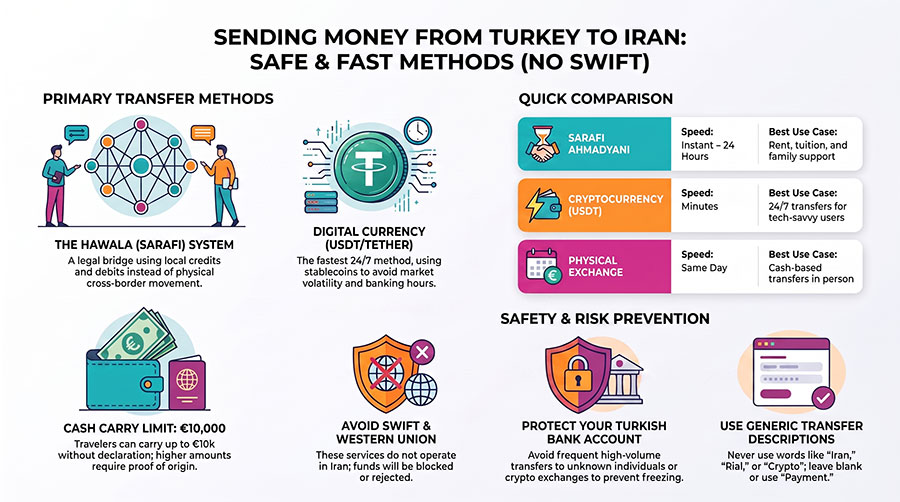
| Transfer Method | Destination Country | Speed | Best Use Case |
|---|---|---|---|
| Sarafi Ahmadyani (Havale System) | Iran | Instant – 24 hours | Sending rent, tuition, or family support to Iran |
| Cryptocurrency (USDT) | Iran | Minutes | 24/7 transfers to Iran for tech-savvy users |
| Physical Sarafi Offices in Turkey | Iran | Same day | Cash-based transfers to Iran |
| Carrying Cash via Travelers | Iran | Flight time | Small personal transfers to Iran |
| Online Intermediary Platforms | Iran | 1–3 days | Limited small payments to Iran |
Send Money from Turkey to Iran |Sarafi Ahmadyani Services
The most direct and secure solution for your financial needs is to use a specialized remittance service like Sarafi Ahmadyani. This method eliminates the complexity of cryptocurrencies and the risks of carrying cash by offering a seamless bank-to-bank experience through a trusted intermediary.
Sarafi Ahmadyani has established a robust infrastructure specifically designed to facilitate transfers in the Turkey-Iran corridor. Unlike general exchange offices that might deal with dozens of currencies, they specialize in the specific compliance and logistical needs of Iranians. This focus allows them to offer a service where you can send money from Turkey to Iran instantly, converting Lira (TRY), US Dollars (USD), or Euros (EUR) directly into Iranian Rials (IRR).

Speed and Reliability
One of the primary concerns for anyone sending money is time. Standard international transfers, if they were possible, would take days. With Sarafi Ahmadyani, the process is designed for speed. In most cases, the transfer is instant. The moment your funds clear in their Turkish account, the equivalent Rials are released to your destination account in Iran via the local banking network (Shaba or Card-to-Card). Even during peak hours, delays rarely exceed a few hours.
Step-by-Step Transfer Process
To ensure clarity and ease of use, the service follows a strict but simple protocol:
- Step 1: Contact Support. You begin by messaging their dedicated support team on WhatsApp or Telegram. This direct line of communication ensures you are speaking to a real person who can guide you.
- Step 2: Lock the Rate. Currency markets are volatile. The rate for Lira to Rial can change within minutes. You will receive a quote, and once you accept, that rate is locked for a specific time window. This guarantees that you know exactly how much the recipient will get.
- Step 3: Deposit Funds. You will be provided with a trusted IBAN for a Turkish bank account (such as Ziraat, İşbank, or Garanti). You transfer the agreed amount of Lira or USD to this account using your mobile banking app.
- Step 4: Settlement in Iran. Once the receipt is confirmed, you provide the Iranian bank details (Shaba number or 16-digit card number). The system immediately processes the payout in Iran.
KYC and Security
Security is paramount, but it should not be burdensome. To comply with regulations and prevent fraud, you are required to perform a simple Know Your Customer (KYC) check. This usually involves sending a selfie with your ID card and the target account number. This one-time verification protects both your funds and the integrity of the exchange service. By choosing Sarafi Ahmadyani, you are choosing a partner that prioritizes the safety of your transaction above all else.
according to swift :
In an increasingly global economy, financial institutions are more vulnerable to illicit criminal activities. Know Your Customer (KYC) standards are designed to protect financial institutions against fraud, corruption, money laundering and terrorist financing.
KYC involves several steps to:
- establish customer identity;
- understand the nature of customers’ activities and qualify that the source of funds is legitimate; and
- assess money laundering risks associated with customers.
Know More About Sending Money from Turkey to Iran
To make informed decisions, it is essential to understand the financial landscape and why specific methods are necessary. The banking relationship between Turkey and Iran is unique, shaped heavily by international politics and economic sanctions.
The Impact of Global Sanctions
The primary reason you cannot walk into a Turkish bank and request a transfer to Tehran is the disconnection of Iranian banks from the SWIFT network. SWIFT is the global messaging system that banks use to settle cross-border payments. Without access to SWIFT, Iranian banks are effectively invisible to the international banking community. Consequently, major financial institutions in Turkey block direct transactions to Iran to avoid penalties from the United States and the European Union. Furthermore, global remittance giants like Western Union and MoneyGram do not operate branches in Iran, leaving a significant gap in services.
The Hawala System: A Legal Bridge
Since the official electronic highways are closed, the financial flow moves through a parallel, fully legal system known as Hawala (or Sarafi). When you want to send money from Turkey to Iran using this method, no physical money actually crosses the border. A very similar settlement mechanism is also used in South Asia, particularly in how to send money from iran to pakistan, where banking channels face comparable restrictions. The process works on a system of credits and debits between two trusted offices.
Here is how it works technically: You pay the exchange office in Istanbul. They add this amount to their local capital. Simultaneously, they instruct their partner office in Tehran to pay the equivalent amount from their existing capital in Iran to your recipient. Because the money never crosses a border, it does not violate banking sanctions related to SWIFT. This ancient system has been modernized with digital tools, making it the backbone of trade and personal finance for millions of people.
Common Methods for Money Transfer from Turkey to Iran
While the Sarafi method is the most robust, there are several ways to move capital depending on your specific needs, risk tolerance, and technical skills. Here is a comprehensive overview of the available channels:
- Digital Currency (Tether/USDT) – Best for tech-savvy users requiring 24/7 access.
- Iranian Exchange Offices (Sarafi) in Istanbul – Best for those who prefer physical cash transactions.
- Transfer via Traveler (Cash) – Suitable only for small, personal amounts.
- Online Intermediary Platforms – Useful for specific small payments but often come with higher fees.
Below, we will explore each of these methods in depth, providing practical advice on how to execute them safely. For users transferring funds in the opposite direction, it is also useful to understand how to send money from iran to turkey and the different risks involved.

Transfer via Digital Currency (Tether/USDT) – The Modern Way
In recent years, cryptocurrency has emerged as a powerful alternative to traditional finance, particularly for those looking to send money from Turkey to Iran quickly and cheaply.
Why Tether (USDT) is the Standard
When we talk about crypto for remittance, we are almost exclusively talking about Tether (USDT). Tether is a stablecoin, meaning its value is pegged 1:1 to the US Dollar. This solves the biggest problem of cryptocurrency: volatility. If you use Bitcoin, the price could drop by 5% in the hour it takes to transfer. With USDT, 100 dollars remains 100 dollars. This stability makes it perfect for payments and remittances.
Detailed Process for Users in Turkey
To use this method effectively, you need to set up a bridge between your Turkish bank account and the crypto world:
- Turkish Exchange Account:You must open an account with a local Turkish exchange like BtcTurk, Paribu, or Binance TR. These platforms are fully regulated and allow you to deposit Lira directly from your bank account via Havale or FAST transfer.
- Purchase USDT:Once your Lira is deposited, you use the Market feature to buy USDT.
- Transfer to Iran:You will need a destination wallet address. This is usually provided by your Iranian exchange (like Sarafi Ahmadyani) or the individual recipient who has a crypto wallet. You initiate a Withdrawal of USDT from your Turkish exchange to this address.
- Settlement:The recipient receives the USDT instantly and sells it for Rials in Iran.
Pros and Cons
The advantages are significant. The blockchain runs 24/7, so you are not restricted by banking hours or holidays. Fees on the TRC20 network (Tron network) are very low, typically around 1 USD per transaction regardless of the amount. However, there is a learning curve. If you send funds to the wrong network (e.g., sending ERC20 tokens to a TRC20 address), the money can be permanently lost. Additionally, as we will discuss later, frequent interaction with crypto exchanges can flag your bank account.
Iranian Exchange Offices in Turkey (Physical & Online)
For decades, the physical exchange office (Sarafi) has been the cornerstone of the Iranian community’s financial life in Turkey. These offices are often located in hubs like Aksaray, Laleli, and the Grand Bazaar.

The Physical Experience
For many, there is comfort in face-to-face business. You can visit these offices, hand over your cash (Lira, Dollars, or Euros), and watch them process the order. They will usually give you a printed receipt or a handwritten note confirming the transaction details. This method is preferred by tourists or those who are paid in cash and do not want to deposit funds into a bank account first.
The Online Evolution
Top-tier providers like Sarafi Ahmadyani have digitized this experience. Instead of carrying cash through the busy streets of Istanbul, which carries a risk of theft, you can conduct the entire transaction via bank transfer. This Online Sarafi model combines the trust and legality of a physical office with the convenience of modern banking. You transfer to their vetted bank accounts, and they handle the rest. This creates a digital paper trail that can be useful if you ever need to prove the legitimacy of your transaction.
Carrying Cash via Travelers (Customs Rules)
The oldest method of all is simply putting cash in your pocket and flying to Iran. While simple, it is strictly regulated.
Customs Regulations
You must legally adhere to customs limits. Currently, passengers leaving Turkey can carry up to €10,000 (or its equivalent in other currencies) without declaring it. If you are carrying more than this amount, you must visit the customs office at the airport before your flight to declare the funds. You will need to provide proof of where the money came from (e.g., a bank withdrawal receipt or property sale document).
Risks and Warnings
The primary risk here is physical safety. Traveling with large amounts of cash makes you a target. Additionally, if you fail to declare amounts over the limit, customs officers have the authority to confiscate the entire amount and issue a heavy fine. Furthermore, once you arrive in Iran, you still need to find a local exchanger to convert your foreign currency into Rials, which might not offer the best rate compared to a professional remittance service. This method is best reserved for small gifts or personal travel expenses.
Why Western Union and SWIFT Don’t Work?
A common misconception among newcomers is that global brands like Western Union are available everywhere. It is vital to clarify that Western Union does not operate in Iran.
Avoid Scams
If you search online, you might find websites claiming to offer Western Union to Iran. Be extremely cautious. These are almost certainly scams or unauthorized third-party brokers charging extortionate fees. Western Union’s internal compliance systems are programmed to block any transaction that lists Iran as the final destination. Similarly, attempting a SWIFT transfer through your bank will result in failure. The funds will either be rejected immediately or stuck in an intermediary bank for compliance review, which can take months to resolve. Do not waste your time or risk your funds attempting these routes.
Important Fees and Transfer Limits
When you prepare to send money from Turkey to Iran, you must look beyond the advertised commission and understand the total cost of the transfer.
The Exchange Rate Spread
Most professional exchange offices do not charge a separate service fee like banks do. Instead, they incorporate their cost into the exchange rate. This is called the spread. For example, if the mid-market rate for 1000 Lira is a specific amount of Rials, the exchange might offer you slightly less. The difference covers their overhead, staff, and liquidity costs. Sarafi Ahmadyani is known for maintaining a highly competitive spread, ensuring you get a rate very close to the wholesale market price.
Hidden Costs in Crypto
If you use cryptocurrency, be aware of the layered fees.
1. Fiat Deposit Fee: Some banks or exchanges charge a small fee to deposit Lira.
2. Trading Fee: The Turkish exchange takes a commission (0.25% – 0.35%) when you buy USDT.
3. Network Fee: Sending USDT requires a network fee (gas fee). On TRC20, this is roughly $1. On ERC20 (Ethereum), it can be $10 or more. Always verify which network you are using.
Banking Limits in Iran
On the receiving end, Iranian banking rules dictate how much you can deposit.
Card-to-Card: This is for smaller, instant transfers. The limit is typically around 10 to 20 million Tomans per day per card.
Satna/Paya (Sheba): For larger amounts (e.g., tuition, property purchase), Sarafis use the interbank Sheba system. This allows for much higher volumes, often up to 100 or 200 million Tomans in a single transaction. Always discuss your volume needs with the Sarafi beforehand so they can choose the correct transfer method.
Risks of Blocking Turkish Bank Accounts (Important Update)
This is perhaps the most critical advice for Iranian residents in Turkey. Turkish banks are under immense pressure to prevent money laundering and adhere to international sanctions. As a result, their automated systems are very sensitive.

Why Accounts Get Frozen
Banks like Ziraat, Vakif, and İşbank monitor for suspicious activity. This includes:
– Receiving money from many different people and immediately transferring it out.
– High-volume transfers to known crypto exchanges.
– Transfers with descriptions containing sensitive keywords.
How to Protect Your Account
To ensure you can continue to live and bank in Turkey without issues, follow these rules:
1. Use Professional Services: Avoid peer-to-peer (P2P) transactions with strangers on Telegram or WhatsApp. If the person sending you Lira has a tainted account involved in illegal activity, your account will also be flagged by association. Using a corporate or trusted account from a reputable Sarafi protects you from this chain reaction.
2. Watch Your Descriptions: When you send money from Turkey to Iran via a bank transfer to an exchange, never write words like Iran, Rial, Crypto, Dollar, or Exchange in the explanation field. The safest option is to leave it blank. If a description is mandatory, write generic terms like Payment (Ödeme), Debt (Borç), or Rent (Kira).
What is the Best Way to Transfer Money? (Summary)
Your choice of transfer method should align with your specific priorities. Here is a summary to help you decide:
For Speed and Efficiency:
Digital Currency (Tether). If you are comfortable with technology, this is the fastest route. It works nights, weekends, and holidays.
For Safety and Peace of Mind:
Sarafi Ahmadyani. This is the best overall option for most users. It removes the technical risks of crypto and the physical risks of cash. You get a dedicated support team, a fixed rate, and a secure transfer that protects your banking standing.
For Small Amounts:
Traveler Cash. If you are flying anyway, carrying small cash is acceptable, provided you stay within customs limits.
Conclusion
While the political landscape has created significant banking hurdles, the path to send money from Turkey to Iran remains open and secure for those who know how to navigate it. If you are dealing with other sanctioned corridors, you may also want to review how to send money from iran to canada to compare different compliance-friendly transfer routes. You do not need to rely on risky underground dealers or stress over blocked bank accounts. By utilizing professional exchange services, you can ensure your hard-earned money reaches its destination instantly. Whether you choose the modern ease of cryptocurrency or the trusted service of Sarafi Ahmadyani, the key is to prioritize safety and legitimacy. Do not let sanctions paralyze your finances; contact Sarafi Ahmadyani today to lock in the best rate and experience a worry-free transfer.
Frequently Asked Questions
Is it legal to send money from Turkey to Iran?
Yes. Sending money is legal when using compliant methods such as licensed Sarafi (Hawala) services or cryptocurrency. Direct SWIFT bank transfers are blocked, but alternative channels are lawful and widely used.
What is the fastest way to send money from Turkey to Iran?
The fastest options are Sarafi services like Sarafi Ahmadyani (often instant) and USDT cryptocurrency transfers, which usually take only a few minutes.
Can I send money from Ziraat Bank or İşbank directly to Iran?
No. Turkish banks cannot send money directly to Iranian banks due to SWIFT restrictions. You must transfer funds to a Sarafi’s Turkish account, and they will handle the payout in Iran.
Is using USDT safe for transferring money to Iran?
USDT is safe if used correctly. It is a stablecoin pegged to the US Dollar, but users must choose the correct network (TRC20 recommended) and wallet address to avoid permanent loss.
How much money can I send without issues?
There is no fixed legal cap, but large or unusual transactions may trigger bank reviews in Turkey. To reduce risk, use trusted Sarafi accounts and avoid sensitive words in transfer descriptions.