
 فارسی
فارسی
 english

Sending funds to Iran presents unique challenges due to international banking restrictions, but reliable solutions exist for individuals and businesses. Since standard SWIFT transfers are blocked, you must utilize specialized exchange services, cryptocurrencies, or specific intermediaries to move capital safely. This process requires a clear understanding of current exchange rates, transfer fees, and security protocols to ensure your money arrives without complications. In this article, we explain the most effective, legal, and secure methods to send money to Iran in the current financial environment.
| Method | Speed | Cost Structure | Safety Level | Best For |
|---|---|---|---|---|
| Licensed Exchange (Sarafi) | 1–24 hours | 1%–3% exchange spread | Very High | Family support, tuition, business payments |
| Cryptocurrency (USDT) | Minutes | Network + exchange fees | Medium | Urgent, tech-savvy users |
| Bank Wires via Intermediaries | 3–5 business days | High (multiple bank fees) | High | Very large transfers |
| Informal Networks (Hawala) | Variable | Unclear | Low | ❌ Not recommended |
Send Money to Iran
The most direct method to send money to Iran is through specialized remittance providers like Ahmadiani Exchange, which bridge the gap between international banking systems and Iranian financial networks. Unlike standard banks that cannot process these transactions, Ahmadiani allows you to transfer funds from almost any country directly to an Iranian recipient. The primary benefit of using such a service is the ability to bypass the blocked SWIFT network legally. They maintain active accounts in various global hubs, allowing you to deposit funds locally while they settle the equivalent amount in Iran.
Ahmadiani Exchange supports a broad range of major currencies, including the US Dollar, Euro, Turkish Lira, and UAE Dirham. This flexibility implies you do not need to convert your money into a difficult currency before initiating the transfer. Once the exchange receives your funds, they offer flexible delivery options. The recipient in Iran can receive the money directly into their local bank account via the Shetab interbank network, or they can opt for a cash pickup. This is particularly useful for urgent needs where bank processing times might be too slow.
These services cater to various transfer needs. Whether you are supporting family members, settling business invoices, or handling educational expenses like university fees abroad, the process remains consistent and secure. A key advantage is cost-effectiveness. Dedicated exchanges often provide lower fees than general wire services and offer real-time exchange rates updated hourly. Furthermore, with 24/7 support, you can resolve potential issues immediately. Ahmadiani’s physical presence in Iran provides essential local expertise, ensuring that every transaction complies with domestic regulations and global safety standards.
Learn More About Send Money to Iran
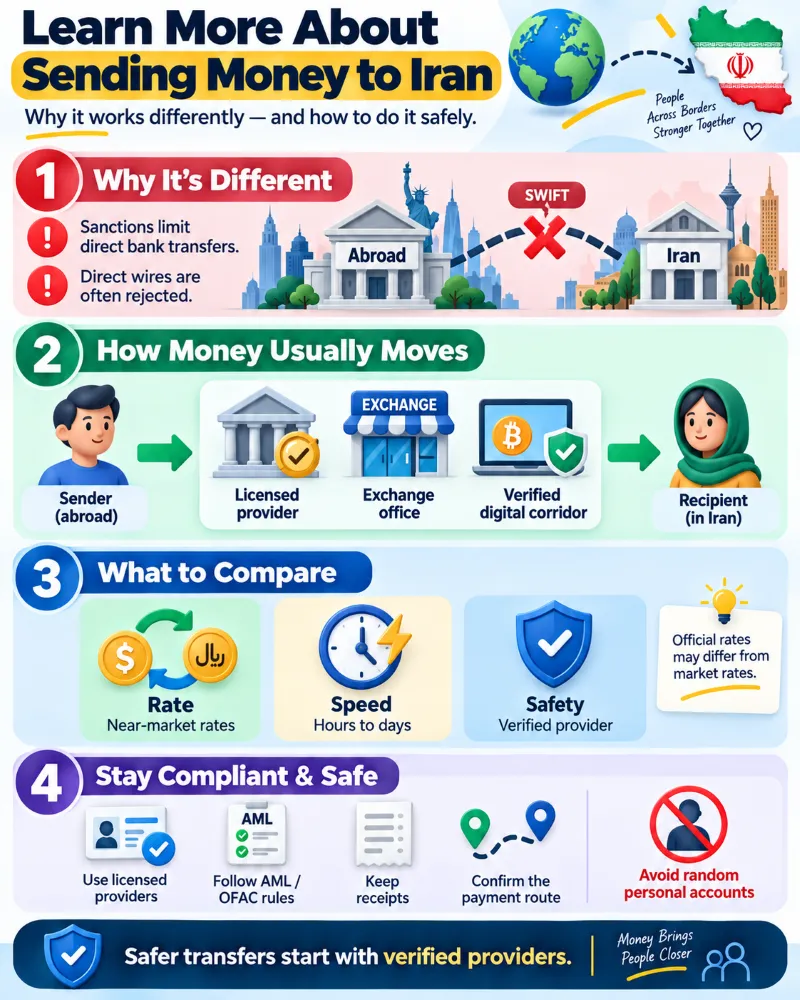
To successfully send money to Iran, you must understand why the process differs from sending money to Europe or Asia. The core issue lies in economic sanctions imposed by Western nations, primarily the United States. These sanctions disconnect Iranian banks from the global financial system. Consequently, a direct wire transfer from a bank in London or Toronto to Tehran will be rejected. Users must therefore rely on intermediaries, specialized exchange offices, or digital assets that operate outside the traditional banking infrastructure to ensure funds reach the recipient safely. This structure is commonly used by users abroad who need to understand how to send money to iran from usa under strict banking restrictions.
In 2025, the landscape for remittances has evolved. While traditional methods remain, licensed providers and digital platforms are now the standard. Using a licensed provider is critical because it ensures your money is handled by an entity following Anti-Money Laundering (AML) protocols. This protects you from legal risks and ensures your transfer does not violate OFAC regulations. The goal is to ensure funds reach the recipient quickly without being frozen by intermediary banks that are wary of Iran-related transactions.
Several factors determine the best method for you. For example, people transferring funds from Europe often compare options when researching how to send money to iran from uk. Exchange rates are the most variable component; the market rate for the Iranian Rial fluctuates significantly against the Dollar and Euro. Professional providers offer rates close to the open market, which is far better than the official government rate. Transfer speed is another consideration; digital methods can settle in hours, while bank wires via third countries may take days. Additionally, while fintech apps are gaining traction, users must verify that the specific provider has a verified corridor to Iran to prevent payment rejections.
Best Ways to Send Money to Iran
There are several distinct methods to transfer funds, each with its own balance of speed, cost, and complexity. If you are looking beyond a single destination, it is also helpful to review how to send money from iran to other countries and compare available transfer corridors. The top methods include:
- Cryptocurrency Transfers: Using digital assets like USDT or Bitcoin for instant settlement.
- Exchange Office Remittances: Using professional services like Ahmadiani for secure bank deposits.
- Bank Wires via Intermediaries: Routing traditional wires through third-party countries.
- Money Transfer Apps: Using global apps to send to an intermediary who forwards the funds.
- Personal Networks: Relying on trusted individuals for informal transfers.
The following sections detail exactly how each method works, their advantages, and what you need to know for 2025.
Cryptocurrency Transfers to Iran
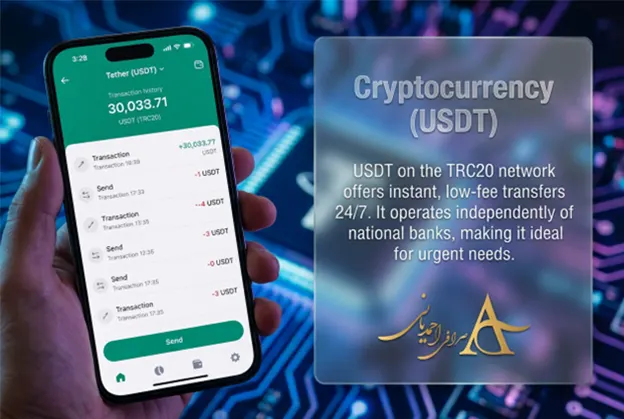
Cryptocurrency is currently the most efficient tool to send money to Iran because it operates on a decentralized network, independent of national banks. This method is available 24/7 and allows for near-instant transfers.
Step-by-Step Guide:
You begin by purchasing cryptocurrency on a global exchange such as Binance, Kraken, or Coinbase. The most recommended asset is Tether (USDT) because it is a stablecoin pegged to the US Dollar, meaning its value remains stable. Once purchased, you transfer the USDT to the recipient’s digital wallet (like Trust Wallet or Exodus). The recipient in Iran then visits a local crypto exchange office to sell the USDT and receive Iranian Rials in their bank account.
Why Choose This Method:
The primary driver is low fees. Transferring USDT via the TRC20 network typically costs less than one dollar, regardless of the transaction size. Speed is also a major factor; funds arrive in the recipient’s wallet within minutes. This makes it ideal for urgent situations. According to Monito (2025), this method is increasingly popular due to its independence from banking hours.
Critical Tips:
- Security: Always double-check the wallet address. Crypto transactions are irreversible.
- Network Selection: Ensure both sender and receiver use the same network (e.g., TRC20 or ERC20) to avoid losing funds.
- Compliance: Check for OFAC compliance to ensure you are not interacting with blacklisted wallets.
Exchange Office Remittances to Iran
Exchange offices, or “Sarafi,” remain the most trusted method for the majority of people. Services like Ahmadiani Exchange provide a seamless experience that mimics a standard bank transfer but with better rates.
If your transfer route starts in North America, you can also compare fees and timelines in our guide: how to send money from canada to iran.
Step-by-Step Guide:
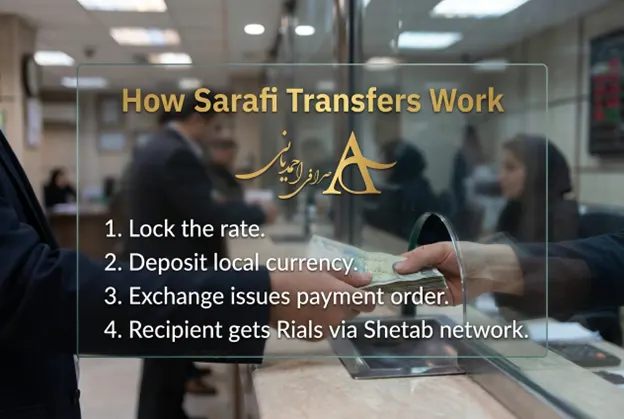
The user contacts the exchange office to lock in a current exchange rate. You then deposit funds in your local currency (USD, EUR, GBP) into the exchange’s designated bank account in your country or a nearby hub like Dubai. Once the exchange confirms receipt, they issue a payment order in Iran. The equivalent amount in Rials is transferred via the domestic banking system (Shetab) to the recipient’s account.
Why This Method is Secure:
This method removes technical barriers. You do not need to understand blockchain. Providers like Ahmadiani are established businesses with physical offices, adding a layer of accountability. They typically have high liquidity, meaning there is no limit on the amount you can send. Execution is fast, often completed within one business day. Their reputation depends on successful delivery, making them highly reliable.
Practical Details:
- IBAN (Sheba): You will need the recipient’s 24-digit Sheba number for a direct bank deposit.
- Receipts: Always request a formal receipt or tracking number.
- Rates: Compare rates from two providers, but prioritize established names like Ahmadiani over slightly cheaper, unknown agents.
Bank Wires via Intermediaries for Iran
For those moving very large sums, such as for property purchases, bank wires via intermediaries are a viable option. This method uses the SWIFT network but routes money through a safe third country.

Step-by-Step Guide:
You cannot wire directly to Iran. Instead, you work with a broker or remittance company with a bank account in a country that trades with Iran, such as the UAE, Turkey, or China. You wire funds to their account in that third country. Upon receipt, the broker instructs their partner in Iran to release funds to your final recipient.
Pros and Cons:
The main advantage is high security for substantial amounts and a formal paper trail. However, it is the slowest method, often taking 3 to 5 business days. It is also more expensive due to multiple bank charges (sender, intermediary, and receiver fees).
Key Considerations:
- Documentation: Have legal documents ready if the source of funds is inheritance or asset sales.
- SDN List: Ensure the intermediary company is not on any sanctions list to avoid your funds being blocked by your bank.
Money Transfer Apps for Iran
Apps like Wise, Remitly, or Ria do not support direct transfers to Iran. However, they are frequently used as the first step in a two-leg transfer process involving a trusted third party.

How It Works:
You use the app to send money to a trusted contact or professional exchange agent in a neighboring country, such as Turkey or the UAE. For example, you send Euros to an agent in Turkey. The agent receives the funds and arranges for the Rial equivalent to be sent to Iran using local banking channels.
Why Use Apps:
These apps offer excellent exchange rates for the first leg (e.g., USD to Turkish Lira) and are easy to use. They are secure and provide tracking for the initial transfer. However, this method relies heavily on the trustworthiness of the person receiving the money in the third country.
Practical Tips:
- Currency Wallets: Use multi-currency accounts to hold different currencies, simplifying the process.
- Debit Cards: Fund the transfer with a debit card to avoid credit card cash advance fees.
Personal Networks for Sending Money to Iran
Informal value transfer systems, often called “Hawala,” rely entirely on personal trust. This is common for smaller amounts or when formal documentation is difficult.
How It Works:
You find a person in your local community (e.g., in the US or UK) who needs to send money out of Iran. You give them your currency locally. In exchange, their family in Iran transfers the equivalent Rials to your recipient. No money physically crosses a border.
Benefits and Risks:
The biggest benefit is the absence of banking fees. The exchange rate is usually agreed upon mutually. The risk is based on trust; if the other party fails to pay in Iran, you have little legal recourse. This method is also slower to organize.
Safety Advice:
- Vetting: Only use this method with people you know personally.
- Tranches: Split large amounts into smaller transactions to minimize risk.
Legal Regulations for Send Money to Iran
Understanding the legal framework is crucial to avoid penalties. The primary regulations are enforced by the US Office of Foreign Assets Control (OFAC), but they influence global banking.
Direct commercial trade and banking with Iran are heavily sanctioned. However, OFAC provides “General Licenses” allowing certain transactions. The most relevant is the allowance for non-commercial, personal remittances. This means you are generally permitted to send money to family for living expenses, student support, or personal gifts, provided the transfer does not involve the Iranian government or sanctioned entities (SDNs).
For business transactions, rules are stricter. You typically cannot export services or goods to Iran without a specific license. If conducting a business transfer, consult a lawyer specializing in sanctions. Compliance involves screening the recipient against the SDN list and maintaining detailed records of the transaction, including purpose and source of funds, for at least five years.
ofacblockedfundslawyers says:
Transferring money between Iran and the USA or Europe has become extremely difficult due to strict restrictions by the Office of Foreign Assets Control (OFAC). Banking relations between the countries are officially prohibited. This means that traditional methods, such as SWIFT, are unavailable. The lack of access to such standard tools forces people to look for alternative ways to transfer money from their bank accounts to Iran. Most often, private intermediaries or small financial services in a third country operating outside the traditional banking system are used for this purpose.

Costs and Fees to Send Money to Iran
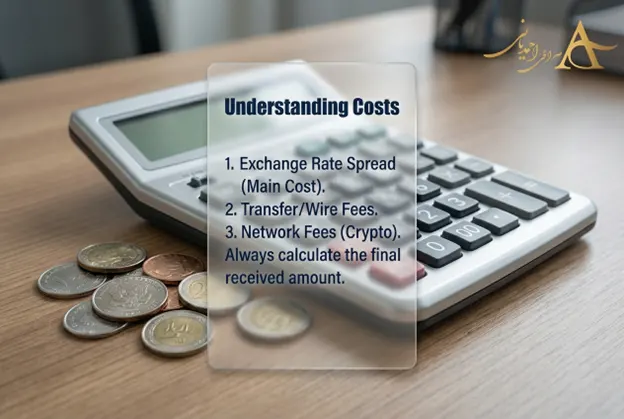
The total cost of a transfer combines upfront fees and the exchange rate margin. You must calculate the final amount the recipient receives to understand the true cost.
Fee Breakdown:
- Cryptocurrency: Usually the cheapest. Network fees for USDT are under $1. Exchange trading fees are around 0.1% to 0.5%. The recipient pays a small fee to convert crypto to Rial in Iran.
- Exchange Offices: These services charge a margin on the exchange rate rather than a high fixed fee. The spread ranges from 1% to 3%. This covers their service and liquidity.
- Bank Wires: The most expensive. You pay a wire fee ($20-$50), a correspondent bank fee ($20-$30), and an exchange rate markup of 3% to 5%.
To get the best deal, check the “free market rate” of the Iranian Rial. Providers like Ahmadiani update rates hourly, helping you capture favorable movements. Be wary of “zero commission” claims, as the cost is almost always hidden in a poor exchange rate.
Safety Tips to Send Money to Iran
Safety is the top priority when moving money to a sanctioned jurisdiction. Following strict protocols protects your capital from scams.
- Verify Licenses: Ensure the exchange office is registered and has a physical address. Avoid entities operating solely through social media without a website.
- Beware of Phishing: Scammers create fake websites looking like legitimate exchanges. Check the URL and look for secure connection indicators.
- Use Two-Factor Authentication (2FA): Enable 2FA on crypto exchanges and money transfer apps. This prevents unauthorized access even if your password is compromised.
- Track Your Transfer: Use services providing real-time tracking. You should know when money leaves your account and when it settles in Iran.
- Start Small: With a new provider, send a test amount (e.g., $100). Once the recipient confirms receipt, proceed with larger amounts.
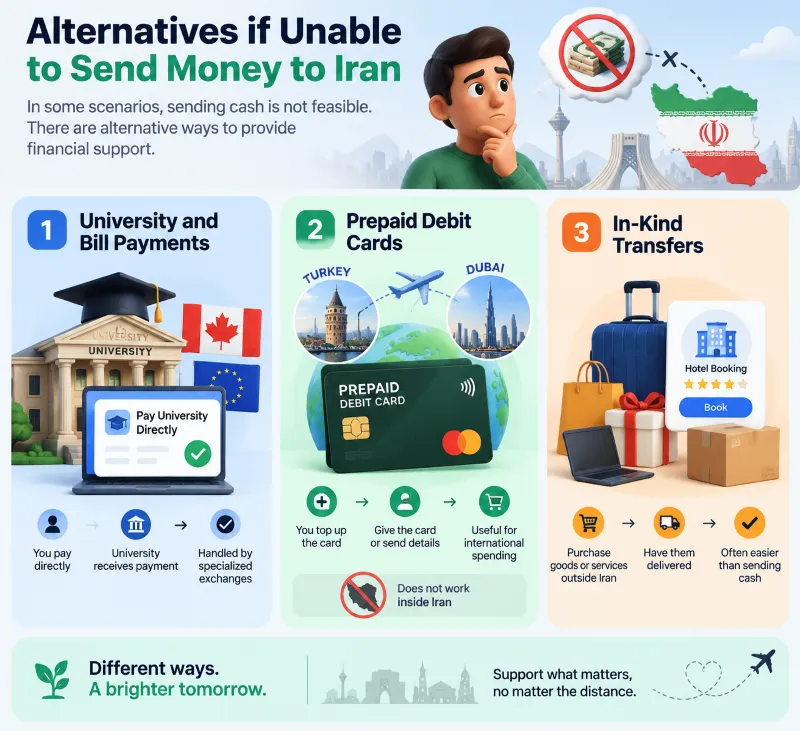
Alternatives if Unable to Send Money to Iran
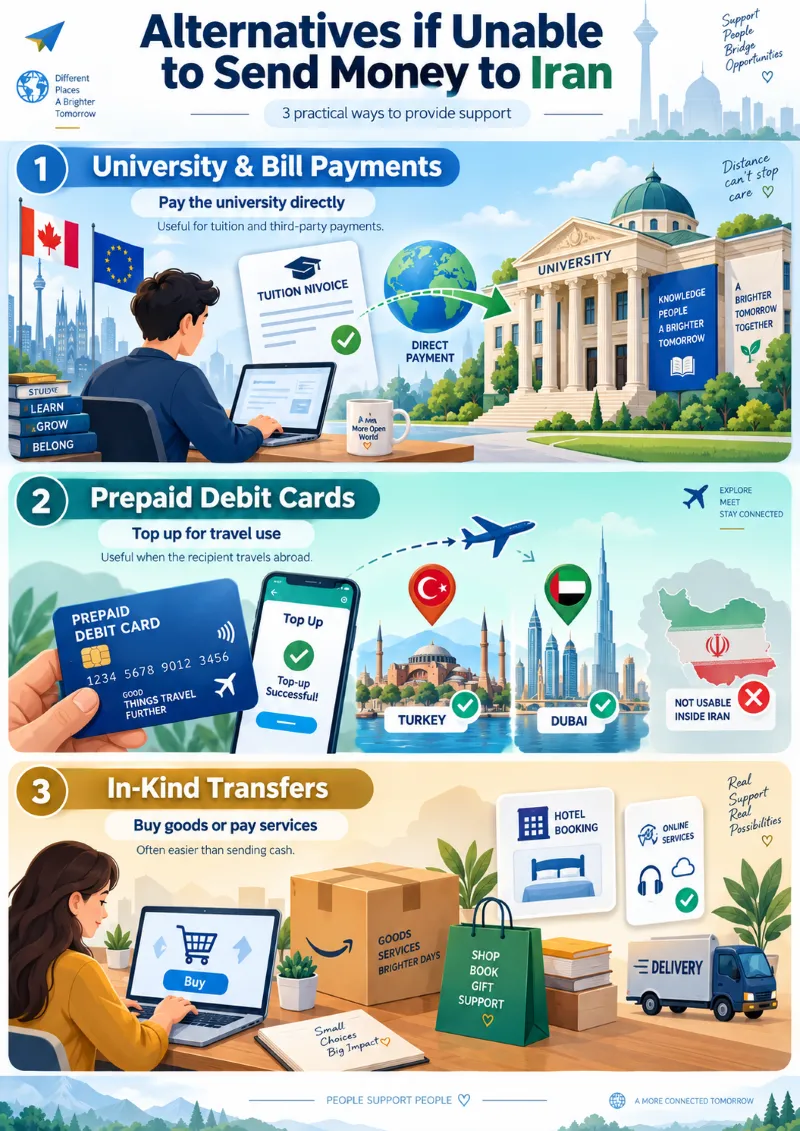
In some scenarios, sending cash is not feasible. There are alternative ways to provide financial support.
University and Bill Payments:
If you are sending money for a student’s university fee in Canada or Europe, pay the university directly from your country. Specialized exchanges often handle these “third-party payments” efficiently.
Prepaid Debit Cards:
Some fintech services offer prepaid debit cards you can top up. While these do not work inside Iran, they are useful if the recipient travels to Turkey or Dubai. You can hand over the card or send details, allowing international spending.
In-Kind Transfers:
This involves purchasing goods outside Iran and having them delivered. In many cases, paying for a service (like a hotel booking for a trip abroad) is easier than sending cash.
Send Money to Iran from Specific Countries
Your location significantly impacts your options. Regulations and banking relationships vary by country.
Send Money to Iran from USA
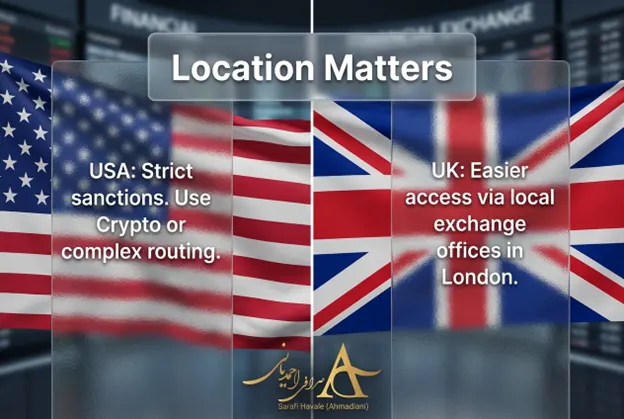
The US has the strictest sanctions. Direct wire transfers from US banks are impossible. Residents must use cryptocurrency or route funds through a third country. The most common strategy is converting USD to USDT (crypto) and transferring digitally. Alternatively, use an exchange broker routing funds through Europe, but this requires careful OFAC compliance. Stablecoins are generally the smoothest path for US residents.
Send Money to Iran from UK
The UK has a large Iranian community, making the process easier. Physical exchange shops in London specialize in remittances to Iran. Residents can use local bank transfers to send GBP to these companies, which settle payment in Iran via local partners. When sending from the UK, compare rates among providers as high competition often leads to better deals.
Conclusion
Sending money to Iran in 2025 is manageable if you choose the right method. While direct banking remains closed, options like cryptocurrency, specialized exchange offices like Ahmadiani, and intermediary wires provide secure alternatives. By understanding costs, legal requirements, and safety protocols, you ensure funds reach their destination. Prioritize licensed providers and stay informed about regulations to protect your assets during the transfer.
Frequently Asked Questions
What is the safest way to send money to Iran?
The safest method is using a licensed exchange office (Sarafi) such as Ahmadiani Exchange. These providers legally bridge international funds to Iran’s domestic banking system and offer receipts and customer support.
Is it legal to send money to Iran?
Yes. Personal, non-commercial remittances (family support, gifts, student expenses) are generally permitted under international regulations when no sanctioned individuals or entities are involved.
How much does it cost to send money to Iran?
Costs depend on the method. Cryptocurrency is usually cheapest, while exchange offices charge a 1%–3% rate spread. Bank wires via intermediaries are the most expensive due to multiple fees.
How long does a money transfer to Iran take?
Crypto transfers can arrive within minutes. Exchange office transfers typically take 1–24 hours. Intermediary bank wires may take 3–5 business days.
Can I use PayPal or Western Union to send money to Iran?
No. PayPal, Western Union, Wise, and similar services do not operate in Iran due to sanctions. Attempting to use them may result in frozen accounts.