
 فارسی
فارسی
 english

Sending capital internationally from Iran is a significant challenge due to heavy banking sanctions, but modern financial tools have created effective workarounds. Traditional SWIFT transfers are generally blocked, leaving business owners, students, and families looking for reliable alternatives. You do not need a traditional bank to move funds successfully. This article explores the most practical methods, focusing on cryptocurrency and specialized exchange services that bypass these barriers. We will guide you through the fastest and most secure ways to get your money to Accra instantly.
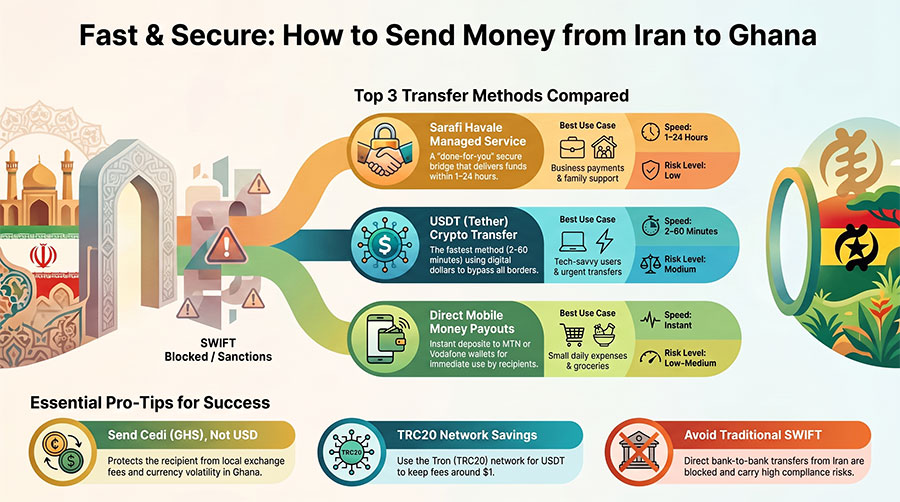
| Transfer Method | Speed | Risk Level | Best Use Case |
|---|---|---|---|
| Sarafi Havale (Managed Service) | Same day – 24 hours | Low | Sending money to Accra, Ghana for family support or business payments |
| USDT (TRC20) + Cash-out platforms | 2–60 minutes | Medium | Fast transfers to Ghana if the recipient can sell USDT (e.g., Yellow Card / Binance P2P) |
| Mobile Money payout (MTN/Vodafone/Telecel) | Minutes – same day | Low–Medium | Daily expenses in Ghana with instant wallet notification |
| Indirect hawala / wire via third countries | 3–10 working days | Medium–High | Large corporate transfers to Ghana with invoices and paper trail |
| Traditional SWIFT from Iran | Blocked | Very High | Not possible for Iran → Ghana corridor |
How to send money from Iran to Ghana?
The most reliable solution for your needs is to use a professional exchange service like Sarafi Havale (Ahmadiani). This service is specifically designed to handle the complexities that ordinary banks cannot manage. They act as a secure financial bridge, allowing you to deposit funds in Iran and ensuring the equivalent amount is paid out in Ghana without you needing to navigate the technical difficulties of international wire transfers yourself.
When you are looking for how to send money from Iran to Ghana, reliability is usually the biggest concern. If you are transferring funds to East Africa as well, you may want to compare this process with how to send money from iran to kenya to understand the differences in payout options. Sarafi Havale eliminates the uncertainty. The process is streamlined to be as easy as a local domestic transfer. You simply contact their support team to lock in the daily exchange rate. Once the rate is agreed upon, you transfer Rials to their designated Iranian bank account via Satna or Paya. The exchange then utilizes its network in West Africa to deposit Ghanaian Cedis (GHS) or US Dollars directly to the recipient.
One of the distinct advantages of this service is the simplified Know Your Customer (KYC) process. In a traditional banking environment, you might be asked for endless documentation, tax returns, and source of funds declarations that take weeks to process. Sarafi Havale understands the urgency of your situation. They require only a clear selfie with your national ID card and a photo of the bank card used for the transfer. This balances security with convenience, ensuring that legitimate users can move money quickly without bureaucratic delays.
This managed service is particularly valuable if you are not comfortable with technology. You do not need to manage a digital wallet or understand blockchain addresses. The Sarafi Havale team handles the conversion and the cross-border movement. You receive a receipt, and the recipient gets their funds, often on the same day. It is a “done-for-you” service that prioritizes peace of mind.

Learn more about sending money from Iran to Ghana
To navigate this financial landscape effectively, it is important to understand why the process is so difficult and how currency choices impact your costs. The difficulty stems primarily from economic sanctions that have disconnected Iranian banks from the SWIFT messaging system. This means a direct wire transfer from Tehran to Accra is impossible. Money must travel through intermediaries in neutral countries like the UAE or Turkey, which adds layers of complexity and cost. A comparable intermediary-based route is also common for North America, especially for users researching how to send money from iran to canada under similar restrictions.
A critical factor often customized is the choice of currency. When considering how to send money from Iran to Ghana, many people default to sending US Dollars. However, in Ghana, the local economy runs on the Cedi (GHS). While USD is a strong currency, sending it can sometimes be a burden for the recipient. If you send Dollars, the recipient must find a local exchange bureau to convert the cash into Cedi to pay for rent, school fees, or groceries. These local bureaus often charge a margin, meaning the recipient loses value.
It is often more strategic to send Cedi directly. By fixing the rate at the point of transfer in Iran, you ensure the recipient gets the exact amount they expect. Market rates fluctuate constantly. If the value of the dollar drops slightly while the money is in transit, the receiver gets less. Sending GHS protects them from this volatility. Furthermore, dealing in the local currency is faster because it can be deposited directly into local digital systems without further conversion steps.
Additionally, having a clear paper trail is easier when dealing with direct exchanges. When you use a reputable provider, you have proof of payment in Rials and proof of receipt in Cedis. This clarity is helpful for businesses that need to balance their books or students who need to prove to their universities that fees have been paid.
Transfer via cryptocurrency to Ghana
This method is the fast and risky solution, the most modern, fastest, and often cheapest way to move funds. Cryptocurrency ignores national borders and banking hours, making it an ideal tool for solving the problem of how to send money from Iran to Ghana. The key to this method is not Bitcoin, but a stablecoin called USDT or Tether.
USDT is a digital dollar. One USDT is always equivalent to one US Dollar. This stability makes it perfect for payments because you do not have to worry about the price crashing while the money is being sent. The process involves buying USDT in Iran using Rials (through Sarafi Havale or other local desks) and then sending that USDT to the recipient’s digital wallet. The transfer on the blockchain typically takes between two to five minutes, regardless of whether it is a holiday or the middle of the night.
However, the most critical part of this process is how the recipient in Ghana turns digital tokens into usable cash. This is where many competitors fail to give advice. In Ghana, there are specific platforms that bridge the gap between crypto and the real world.
Top Platforms for Cashing Out in Ghana
You should guide your recipient to use one of the following reputable platforms:

1. Yellow Card
Yellow Card is a dominant force in African fintech. It is an app designed specifically for buying and selling USDT in local African currencies.
How it works: The recipient creates an account and verifies their identity. You send USDT to their Yellow Card wallet address. They tap “Sell” and the funds are instantly converted to Cedi. The best part is that Yellow Card allows for immediate withdrawal to Mobile Money wallets. It is seamless and user-friendly.
2. Binance P2P
Binance is the world’s largest exchange, and its Peer-to-Peer (P2P) market in Ghana is highly liquid.
How it works: The recipient receives the USDT on Binance. They go to the P2P section and choose to sell their USDT. They will see a list of vetted local agents willing to buy the crypto. The recipient selects an agent, and the agent sends Cedi to the recipient’s Mobile Money or bank account. Binance acts as an escrow service, holding the crypto until the cash is received, making it extremely safe.
3. ZendWallet
This is a more localized solution that integrates well with Ghanaian payment networks. It is a good backup if the major international platforms are undergoing maintenance.
When using this method, always ensure you are using the TRC20 network (Tron Network) for sending USDT. The fees on this network are usually around one dollar, whereas other networks like Ethereum (ERC20) can charge significantly more. This technical detail is crucial for keeping your costs down.
Sending to MTN Mobile Money and Vodafone Cash
If you really want to understand how to send money from Iran to Ghana efficiently, you must look beyond banks. In Ghana, the financial heartbeat is Mobile Money (MoMo). It is more pervasive and accessible than traditional banking. Almost every adult has a mobile wallet linked to their phone number.
according to mtn:
Mobile Money is a Financial service which can be accessed on your mobile phone and allows you to send and receive money, pay bills, receive money from abroad as well as access Loans and savings from the palm of your hand.

The primary providers are MTN Mobile Money, Vodafone Cash (now transitioning to Telecel), and AirtelTigo Money. MTN is by far the market leader. These wallets allow users to pay for goods at the market, settle utility bills, buy airtime, and withdraw cash at thousands of agent kiosks located on nearly every street corner in the country.
Competitors often ignore this method, focusing on SWIFT codes. This is a mistake. Sending to a bank account in Ghana can take days to clear, and banks often have limited operating hours. Mobile Money is instant. As soon as the transfer is processed, the recipient’s phone beeps with an SMS notification: “You have received GHS…” The funds are immediately available for use.
When you use Sarafi Havale, you can specifically request a Mobile Money deposit. For another corridor where exchange services and mobile-wallet style payouts are frequently used, see how to send money from iran to pakistan. You do not need to send crypto yourself to do this. You simply provide the recipient’s Mobile Money number and their registered name. The exchange utilizes its local liquidity to credit that specific wallet. This is incredibly convenient for the recipient as they do not need to travel to a city center or stand in line at a bank branch.
There is a practical detail to keep in mind regarding “Tier Limits.” In Ghana, Mobile Money accounts have transaction limits based on how much ID verification the user has provided. A basic wallet might have a limit of 2,000 GHS, while a fully verified wallet can hold significantly more. Before sending a large sum, always ask the recipient if their wallet has enough space to receive the funds. If the wallet is full, the transaction will fail or hang.
Bank transfer and SWIFT limitations
While we have focused on modern methods, it is necessary to address traditional banking to understand why it should be your last resort. You cannot simply walk into an Iranian bank and request a transfer to Ghana. The SWIFT network blocks these direct paths.
The only way to achieve a “Bank Transfer” is through a complex web of third-party intermediaries. This usually involves paying a hawala office in Iran, who instructs a partner in Dubai or Turkey to send a wire transfer to the Ghanaian bank. While this technically answers how to send money from Iran to Ghana, it is fraught with inefficiencies.
First, the duration is unpredictable. A transfer that should take three days can easily take seven or ten working days if there is a public holiday in any of the countries involved or if a correspondent bank holds the funds for review. Speed is rarely a feature of this method.
Second, the costs are high. You are effectively paying fees to three different entities: the sender in Iran, the intermediary in the third country, and the receiving bank in Ghana, which often charges an “inward remittance fee.” These costs eat into your capital significantly.
Third, and most importantly, is the compliance risk. Ghanaian banks are becoming increasingly strict about Anti-Money Laundering (AML) regulations. If a large sum arrives from a trading company in Turkey for a personal account in Accra, the bank’s compliance department may flag the transaction. They will freeze the funds and demand “Source of Funds” documents, invoices, and explanations. This can delay access to the money for weeks. We generally recommend this method only for large corporate transactions where formal invoices exist and a paper trail is legally required.
Comparison of transfer fees and duration
Making the right choice depends on comparing the trade-offs between speed, cost, and convenience. Here is a structured breakdown of the methods discussed.

1. Crypto/USDT (The Modern Choice)
- Speed: Instant to 1 hour. This is the fastest option available.
- Fee: Very Low. You pay a small network fee (approx. $1) and the exchange spread.
- Security: High. The blockchain is transparent and immutable.
- Best For: Tech-savvy individuals, urgent transfers, and those wanting full control.
2. Sarafi Havale Direct Service (The Managed Choice)
- Speed: 1 to 24 hours. Most Mobile Money transfers happen same-day.
- Fee: Medium. You pay a service fee for the convenience and risk management.
- Security: Very High. The exchange guarantees the arrival of funds.
- Best For: Business payments, supporting family, and users who prefer a “concierge” style service.
3. Traditional Hawala / Wire (The Old Choice)
- Speed: 3 to 7 Days. Highly variable and slow.
- Fee: High. Multiple intermediaries take a cut.
- Security: Moderate. High risk of bank compliance freezes.
- Best For: Very large corporate contracts exceeding $50,000.
A hidden cost you must watch for is the exchange rate spread. Some providers advertise “Zero Commission” but give you a terrible exchange rate. For example, if the real rate is 15 Cedis to the dollar, they might offer you 13. On a large transfer, this is a massive hidden fee. Always compare the “amount to be received” rather than just the upfront fee. Sarafi Havale prioritizes transparency so you know exactly what the recipient will get.
Essential security tips for Iran to Ghana transfers
The corridor between the Middle East and Africa is active, but it also attracts opportunistic scammers. Protecting your money requires vigilance. Here are practical tips to ensure your transaction is safe.
Beware of Social Media Agents: Do not trust individuals on Instagram, Telegram, or WhatsApp who claim to be money transfer agents but lack a physical office or a reputable website. Scammers often create convincing profiles, take your Rials, and then block you. Always work with established businesses like Sarafi Havale (Ahmadiani) that have a track record and a physical presence.
Check the Market Rate: Before agreeing to a transfer, use Google to check the current USD to GHS rate. This gives you a baseline. If an agent offers you a rate that is significantly better than the market rate, it is almost certainly a scam. If the rate is significantly worse, they are overcharging you. Being informed is your best defense.
Verify Recipient Details Twice: This is crucial for Mobile Money. Unlike bank transfers, which verify the account name before sending, some older systems or quick transfers can be unforgiving. If you mistype a digit, you might send money to a stranger. Transactions on the blockchain or Mobile Money are generally irreversible. Always read the number back to the recipient and confirm the name associated with the number.
Test Small Amounts: If you are sending a large amount of money to a new recipient or using a new wallet address for the first time, send a small “test transaction” first (e.g., $10). Once the recipient confirms they have received it, you can safely send the rest.
Conclusion
Sending money from Iran to Ghana is no longer the impossible task it once was. While banking sanctions have closed the main doors, technology and specialized services have opened secure side doors. You have reliable options that are faster and often cheaper than the old banking methods.
If you are comfortable with digital tools, using USDT provides the ultimate freedom and speed, solving the issue of how to send money from Iran to Ghana in minutes. For those who prefer a professional, managed experience, Sarafi Havale offers a secure service that bridges the gap between Iranian Rials and Ghanaian Mobile Money. By avoiding traditional banks and leveraging the speed of local networks like MTN and Vodafone, you ensure your funds arrive safely and instantly.
The most important step is to choose a trusted partner. Do not let geographical borders stop your business or family support. The tools are available; you just need to use them.
Ready to send funds? Contact Sarafi Havale on WhatsApp today to check the current Cedi rate and ensure your money reaches Ghana instantly and safely.
Frequently Asked Questions
Is it legal to send money from Iran to Ghana?
Yes. Sending money for personal or business purposes is legal when using compliant intermediaries such as Sarafi Havale or peer-to-peer cryptocurrency platforms. Direct SWIFT transfers are blocked, but alternative methods are lawful.
What is the fastest way to send money from Iran to Ghana?
The fastest method is USDT (Tether) cryptocurrency, which arrives within minutes. For users who prefer a managed service, Sarafi Havale can deliver funds to Ghanaian Mobile Money accounts on the same day.
Can money be sent directly to MTN Mobile Money in Ghana?
Yes. Sarafi Havale supports direct deposits to MTN Mobile Money, Vodafone Cash (Telecel), and AirtelTigo wallets. This is often faster and more practical than bank transfers in Ghana.
Should I send USD or Ghanaian Cedi (GHS)?
Sending GHS is usually better. It avoids extra exchange fees in Ghana and protects the recipient from currency volatility. USD transfers may require additional conversion steps.
What details are required to make a transfer?
You typically need a selfie with your ID card, a photo of the bank card used for payment, and the recipient’s full name plus their Mobile Money number or bank details.