
 فارسی
فارسی
 english

Sending funds out of Iran is technically challenging due to persistent banking sanctions and the disconnection from the global SWIFT network. In 2025, tightened financial regulations in Europe and stricter crypto monitoring have added new layers of complexity for Iranians. You cannot simply walk into a bank and wire funds; you must use specific intermediaries or digital assets. This article explains the most effective, legal, and secure methods to move your capital abroad safely.
| Method | Speed | Safety Level | Documentation | Best For |
|---|---|---|---|---|
| Sarafi Exchange (Licensed) | 1–3 business days | High | Official receipt, bank trail | Tuition payments, family support, large transfers |
| Bank Partner Transfers | 3–5 business days | Very High | SWIFT / MT103 | Business payments, immigration proof of funds |
| Cryptocurrency (USDT) | Minutes | Medium | Blockchain hash only | Small & urgent transfers, tech-savvy users |
| Hawala (Informal) | Same day | Low | None | Emergency cash, undocumented cases |
How to Send Money from Iran to Other Countries?
The most secure and effective answer to how to send money from Iran to other countries is to utilize a professional exchange service like Sarafi Havale (Ahmadiani). These services are designed to bypass the banking blockade by using a network of international accounts. They do not physically move cash across borders; instead, they use a credit-debit system with partners abroad to settle your payment locally in the destination country.

Sarafi Havale (Ahmadiani) stands out because it offers a structured, corporate-level service rather than a simple street-level exchange. Here are the specific advantages they offer to ensure your peace of mind:
- Global Reach:You are not limited to neighboring countries. They facilitate transfers to over 190 nations, including the USA, Canada, UK, Germany, China, Turkey, and India.
- Currency Diversity:They support all major currencies. You can convert Rials directly to USD, Euro, GBP, CAD, Chinese Yuan (CNY), Turkish Lira, and UAE Dirham.
- Secure Banking Channels:The funds you send arrive via a standard bank transfer (Wire/SEPA/ACH) from a clean, non-sanctioned account. This prevents the recipient’s bank from rejecting the transaction.
- Real-Time Rates:Exchange rates are updated hourly based on the Tehran market, ensuring you get a fair deal without hidden markup shocks.
- Tracking and Speed:Unlike informal methods, you receive a tracking number. Most transfers to Europe or Asia clear within 1 to 3 working days.
- Specialized Payment Support:They are experts in handling university tuition payments (uploading receipts to portals) and paying supplier invoices for importers.
In the sections below, we detail each one of these aspects. If your goal is specifically transferring funds into Iran rather than outbound payments, you can also review our full guide on send money to iran. Using a reputable provider helps you avoid the “frozen funds” scenario. Since the transfer originates from a safe third country like the UAE or Turkey, it appears as a normal business or personal transaction to the receiving bank. This is currently the gold standard for reliable remittance.
Learn More About How to Send Money from Iran to Other Countries
To truly master how to send money from Iran to other countries, you need to understand the background mechanics. Because Iranian banks are sanctioned, they cannot communicate with banks in the West. If a transaction has a “trace” of Iran, it is blocked.
Therefore, the entire system relies on “Third-Party Remittance.” When you give Rials to a Sarafi in Tehran, they contact a partner, perhaps a trading company in Dubai. That partner pays your recipient in Dollars or Dirhams from their Dubai account. Your recipient sees the name of the Dubai company on their bank statement, not your name. This is standard practice.
In 2026, this process requires high precision. Banks in Europe and Canada use AI to scan for sanctions evasion. They look for patterns. A professional Sarafi rotates their accounts and ensures that the “Description of Payment” matches the recipient’s profile (e.g., “Student Support” or “Family Gift”). This attention to detail is what separates a successful transfer from a blocked one. We will explore the technical steps to ensure your money is not just sent, but actually received and cleared.

Top Methods for Sending Money from Iran
There are several distinct ways to move funds, each suited for different needs. The main methods include local exchange services, cryptocurrency, hawala networks, and partner bank transfers. Below is a breakdown of the primary options available today.
- Local exchange services (Sarafi).
- Cryptocurrency transfers.
- Hawala networks.
- Bank transfers via partners.
- Other alternatives like travel agencies.
In the sections below, we detail each one comprehensively. You should choose based on your priority: speed, cost, or documentation. For example, a student needs a paper trail for their visa renewal, making Sarafis the best choice. A freelancer needing rent money might prefer the speed of crypto.

Sending Money from Iran Using Local Exchanges
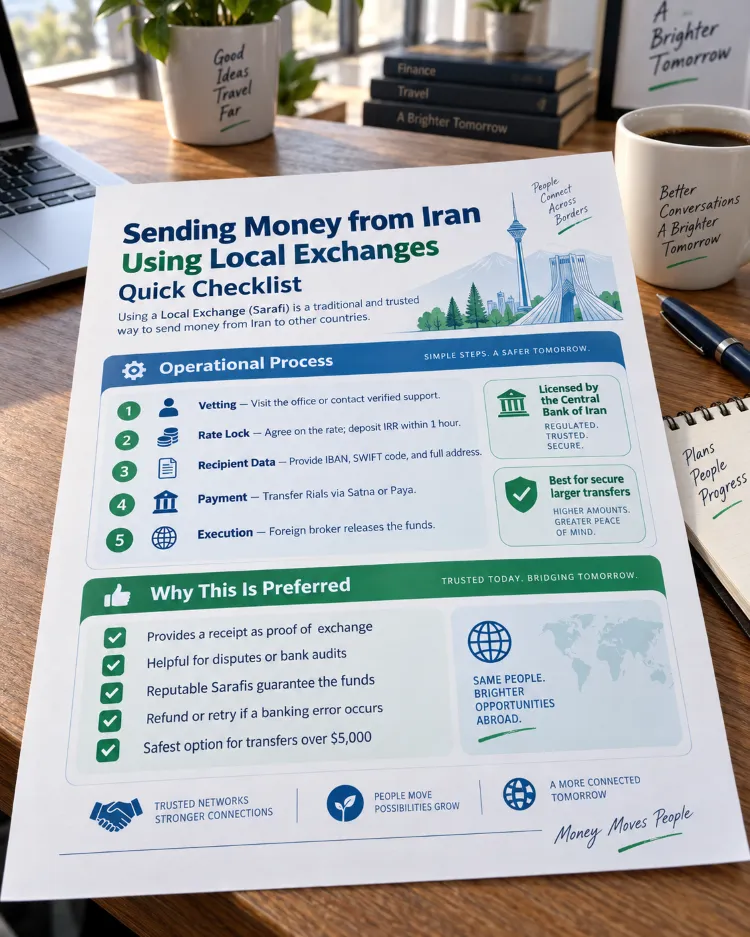
Utilizing a Local Exchange (Sarafi) is the most traditional and widely trusted method for how to send money from Iran to other countries. These are licensed financial houses regulated by the Central Bank of Iran, though their international operations function through private networks. For users whose destination is South Asia, a country-specific breakdown is available in our guide on how to send money from iran to india.
The Operational Process:
- Vetting:You visit the physical office of a provider like Sarafi Havale or contact their verified support.
- Rate Lock:You agree on a rate. Be aware that rates change instantly. Once locked, you usually have 1 hour to deposit the Rials.
- Recipient Data:You must provide the exact IBAN (International Bank Account Number), SWIFT code, and the beneficiary’s full address.
- Payment:You transfer Rials via Satna or Paya (Iranian interbank systems) to the Sarafi’s account.
- Execution:The Sarafi instructs their foreign broker to release the funds.
Why this is preferred: This method provides a receipt. In the event of a dispute or a bank audit in the destination country, you can show the receipt as proof of currency exchange. Reputable Sarafis guarantee the funds. If the money does not arrive due to a banking error, they will refund your Rials or retry the transfer. For amounts over $5,000, this is the safest path.
Sending Money from Iran with Cryptocurrency
Cryptocurrency is the modern answer to how to send money from Iran to other countries, offering speed and autonomy. However, 2025 has brought stricter regulations, known as the “Travel Rule,” which means you must be technically proficient to avoid loss.
Detailed Steps for Safety:
- Choose Stablecoins:Avoid Bitcoin for payments if possible due to volatility. Use USDT (Tether) or USDC on the TRON (TRC20) or Polygon networks for low fees.
- The “Clean” Wallet Strategy:Never send from an Iranian exchange (like Nobitex or Wallex) directly to a foreign exchange (like Binance or Coinbase). The foreign exchange will flag the transaction source and freeze your account.
- Use an Intermediary Wallet:
- Buy USDT on the Iranian exchange.
- Withdraw to a personal non-custodial wallet (e.g., Trust Wallet, Exodus, SafePal).
- From your personal wallet, send to the recipient.
- Privacy Measures:Use a VPN when accessing your wallet. In late 2025, wallet software companies began logging IP addresses more aggressively.
This method is instant (minutes) and works 24/7. It is perfect for amounts under $2,000 or for tech-savvy recipients. However, be careful of “Tether Freezing.” The company behind USDT can freeze wallets associated with sanctions. It is wise not to hold large sums in USDT for long periods; convert to fiat or Bitcoin as soon as possible.
For Southeast Asian destinations, you may also want to compare regulations and risks outlined in how to send money from iran to indonesia.

Sending Money from Iran via Hawala
Hawala is an informal value transfer system based on the performance and honor of a huge network of money brokers. It is the historical predecessor to modern banking and remains a vital part of the Middle Eastern economy.
How it works practically:
- The Agreement:You agree on a total cost in Rials with a local agent (Hawaldar).
- The Token:The agent gives you a code or a picture of a banknote serial number.
- The Handover:You send the code to your recipient. They go to a specific shop (often a currency exchange or gold shop) in their city, present the code, and receive cash.
The Risks: Hawala is fast and leaves no digital footprint, which is good for privacy but bad for legal proof. If you are buying a house or paying tuition, you cannot use Hawala because you cannot prove the “Source of Funds” to authorities. Additionally, receiving cash sums over €10,000 is illegal in many countries without declaration. Use this only for small, personal emergency funds.
Sending Money from Iran through Bank Partners
This is a sub-service of premium Sarafis, focusing on official banking channels rather than cash payouts. This is crucial for answering how to send money from Iran to other countries for business or immigration purposes.
Key distinctions:
- Invoice Based:You submit a Proforma Invoice or a University Fee Notice to the Sarafi.
- Corporate Origin:The money is sent from a registered Trading Company (General Trading LLC) in Dubai, Turkey, or China.
- Purpose Code:The transfer includes a legitimate purpose code (e.g., “Payment for Goods” or “Educational Services”).
This method ensures the receiving bank does not reject the incoming wire. It creates a legitimate paper trail. For example, if you are a Canadian immigrant needing to show proof of funds, a wire transfer from a reputable trading company is often accepted, whereas a bag of cash is not.
Alternative Ways to Send Money from Iran
Sometimes standard financial routes are blocked or too expensive. Here are alternative, often physical, methods.
- Travel Agencies:Many travel agencies in Tehran have accounts in Istanbul or Dubai to pay airlines. You can pay them Rials, and they can transfer Euros or Dollars to your account abroad. This acts like a swap.
- Physical Cash (Passengers):Passengers can legally carry currency out of Iran (currently approx €5,000 per person, but check latest regulations). This is risky due to potential theft or confiscation if you exceed limits at customs.
- Export Settlement:If you know an exporter (e.g., someone selling carpets to Germany), they have Euros in Germany but need Rials in Iran to pay weavers. You can pay their expenses in Iran, and they transfer Euros to your German account. This is a private swap.
Western Union and PayPal are completely banned. Accessing them with an Iranian IP addresses triggers an automated ban. Even with a VPN, they often detect the device location. Do not risk your funds on these platforms.
Step-by-Step Guide to Send Money from Iran
To ensure a smooth transaction, follow this checklist. This applies generally to Sarafis and Bank Partners, the most common methods.
- Determine the Net Amount:Ask your recipient exactly how much they need to receive. If they need exactly $1,000, you must send slightly more to cover intermediary bank fees (usually $15-$30).
- Select the Method:For speed, choose Crypto. For safety and documentation, choose Sarafi Havale.
- Verify the Provider:Check if the Sarafi has a valid license number from the Central Bank. Avoid Telegram-only dealers.
- Gather Recipient Data:Get the IBAN, BIC/SWIFT code, Bank Name, and physical address of the branch.
- Check the Rate:Confirm the “All-in” rate. Some places offer a low rate but add a high commission fee.
- Initiate Transfer:Send the Rials to the Sarafi’s verified bank account. Keep the screenshot of the transaction.
- Wait for Proof:Ask for the “MT103” or “Swift Copy.” This is the official banking receipt that proves the money was sent.
- Confirm Receipt:Do not delete your chats or receipts until the recipient confirms the money is in their available balance.

Legal Regulations for Sending Money from Iran
You must navigate two legal systems: Iranian currency controls and International sanctions.
OFAC Regulations (USA): The US Office of Foreign Assets Control enforces the strictest rules. However, General License D-2 generally allows for non-commercial, personal remittances to Iran and from Iran, provided the transfer does not involve a “Blocked Person” (Sanctioned Entity). This means sending money for family support is technically legal under US law, but the practical difficulty is finding a bank that will process it.
European & Global Rules: In 2025, the EU enforces strict Anti-Money Laundering (AML) checks. Banks are required to know the “Ultimate Beneficial Owner” of funds. If you send money via a Sarafi, the money comes from a third-party company. Your recipient may be asked to explain their relationship to this company. The correct answer is usually: “This is a regulated exchange service acting on behalf of my family in Iran for personal support.”
iranbestlawyer says:
For instance, to transfer money from Iran to the UK, it is necessary to locate a money exchange that is regulated by the Financial Conduct Authority (FCA). Once you have found a suitable exchange, you will need to provide two key pieces of information: (1) proof of the source of the Iranian Rial (IRR) funds and (2) the destination of the British Pound (GBP) funds, which should be your UK bank account. This process is in place to ensure that the funds being transferred do not originate from illegal activities such as money laundering. The transfer of funds between the United Kingdom and Iran necessitates prior approval from HM Treasury.
2026 Updates on Sending Money from Iran
The landscape changes every few months. Here is what is new in 2026 regarding how to send money from Iran to other countries.
- Shadow Fleet Crackdown:The US and EU have targeted the “shadow banking” network in the UAE and Turkey. This means transfers that used to take 1 day might now take 3-4 days as intermediate banks perform more checks.
- Crypto Wallet Screening:Major non-custodial wallets (like Exodus and MetaMask) have integrated geo-blocking features to comply with US law. You must keep your software updated and use a VPN to avoid being blocked from the user interface.
- UAE Visa Restrictions:Changes in UAE banking laws have made it harder for non-resident Iranians to open accounts in Dubai, reducing the number of available intermediaries. This has slightly increased the cost of transfers.
Fees and Costs in Sending Money from Iran
Understanding the cost structure prevents surprises. It is not just about the exchange rate.
- Sarafi Spread:The main cost. If the market rate is 600,000 Rials, they might sell to you at 610,000. This 1-2% difference covers their risk and profit.
- Transfer Fee:A fixed fee (e.g., $30 or €25) is often charged for the SWIFT wire itself.
- Correspondent Bank Fees:As the money moves through the banking system, intermediary banks may deduct $10-$20. Always send a little extra to cover this.
- Crypto Fees:Network fees. TRC20 is cheap (<$1), but ERC20 (Ethereum) can be expensive ($10+). Exchange withdrawal fees also apply.
Timeframes for Sending Money from Iran
Patience is often required. Here are realistic estimates for 2025.
- Cryptocurrency:10 to 30 minutes. The fastest option.
- Hawala (Cash):Same day or next day. fast but risky.
- Sarafi to Europe (SEPA):1 to 2 business days.
- Sarafi to Canada/USA (SWIFT):2 to 4 business days. These routes have the most compliance filters.
- Sarafi to China (Alipay/Bank):Often same day or next day due to better banking relations.
Risks When Sending Money from Iran
The primary risk is not losing money to theft, but having money stuck in “Compliance Limbo.”
- Account Freezing:If the recipient tells their bank “This is from Iran” without providing context, the bank may freeze the account out of caution. It is better to provide the Sarafi’s receipt and explain it as a third-party exchange.
- Scams:Phishing sites pretending to be major exchanges are common. Always double-check the URL.
- Volatility:In the time it takes to drive to the Sarafi, the Rial can devalue. Lock your rate by phone if possible.
Choosing Providers for Sending Money from Iran
To safely answer how to send money from Iran to other countries, you must choose the right partner.
Provider Checklist:
- Physical Office:Do they have a real location you can visit?
- Landline Phone:Do they have a working fixed line, not just a mobile number?
- Account Name:Do you deposit Rials into a corporate account or a random individual’s account? Corporate is safer.
- Transparency:Do they explain the route (e.g., “We send via Turkey”)?
Sarafi Havale (Ahmadiani) scores high on these metrics, offering transparency about the origin of funds and providing consistent support.
Sending Money from Iran for Specific Purposes
The method you choose should depend on *why* you are sending money.
University Payments from Iran
Foreign universities are strict. They often use portals like “Flywire” or “Convera.”
Best Practice: Ask the Sarafi to pay directly to the university’s bank account, not through the portal if possible, or ensure the Sarafi can generate a payment proof compatible with these portals. Always include your Student ID Number in the reference field. Without this, the university cannot allocate the funds to your tuition balance.

Business Imports from Iran
If you are importing machinery or raw materials, you need a commercial invoice.
Best Practice: Use a Sarafi that offers “TT” (Telegraphic Transfer) from a corporate account. Ensure the sender name (the Sarafi’s partner) is not on any sanctions list. Your supplier will need to know the name of the company sending the money to inform their own bank.
Comparison of Methods to Send Money from Iran
This table summarizes the options to help you make a quick decision.
| Method | Safety | Speed | Documentation | Best For |
| Sarafi Havale | High | 2-3 Days | High (Receipts available) | Tuition, Large Family Support, Imports |
| Cryptocurrency | Medium | Minutes | Low (Blockchain only) | Small amounts, Tech-savvy users |
| Hawala | Low | 1 Day | None | Emergency cash, Undocumented needs |
| Bank Partner | Very High | 3-5 Days | Very High (Official Wire) | Large Business Invoices |
Conclusion
Sending capital out of Iran in 2026 is a complex task requiring careful navigation of sanctions and banking rules. You cannot rely on luck; you need a strategy. Whether you opt for the speed of cryptocurrency or the security of a professional service like Sarafi Havale (Ahmadiani), the key is verification and compliance. By understanding the methods of how to send money from Iran to other countries outlined here, you can ensure your funds reach their destination safely, legally, and with minimal fees.
Frequently Asked Questions
What is the safest way to send money from Iran to other countries?
The safest and most reliable method is using a professional exchange service (Sarafi) such as Sarafi Havale (Ahmadiani). These providers use clean third-country accounts and offer official receipts and tracking.
Is it legal to send money from Iran abroad?
Yes. Personal remittances such as family support, education costs, or personal savings are generally legal when handled by licensed intermediaries and when recipients are not sanctioned entities.
How long does it take to send money from Iran internationally?
Cryptocurrency transfers take minutes. Sarafi transfers usually take 1–3 business days, while bank-partner wires for large or business transfers can take up to 5 business days.
What documents are required to send money from Iran?
You typically need the recipient’s full name, IBAN or account number, bank details, and sometimes the transfer purpose. Large transfers may require proof of source of funds.
Can I use PayPal, Wise, or Western Union from Iran?
No. These services do not operate in Iran. Attempting to use them—even with a VPN—can result in frozen accounts and lost funds.