
 فارسی
فارسی
 english

Sending funds between Iran and Pakistan is challenging due to international banking sanctions that block standard wire transfers. You cannot simply use Western Union or PayPal. However, secure local solutions exist that bridge this financial gap effectively for merchants, students, and families. This comprehensive guide details the specific, tested mechanisms available to you. In this article, you will learn exactly how to send money from Iran to Pakistan using trusted exchange bureaus and digital assets securely.
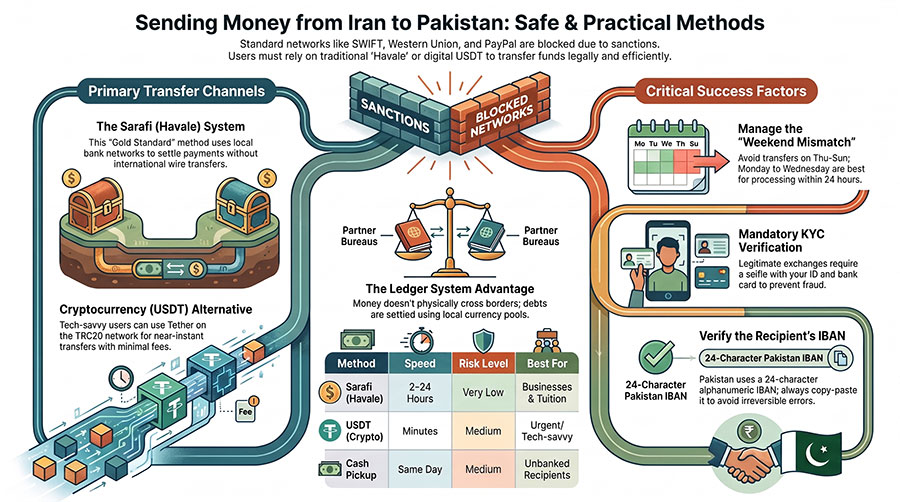
| Method | Speed | Risk Level | Best For |
|---|---|---|---|
| Sarafi (Havale System) | 2–24 hours | Very Low | Families, businesses, tuition payments |
| USDT (Crypto) | Minutes | Medium | Tech-savvy users, urgent transfers |
| Cash Pickup | Same day | Medium | Unbanked recipients |
| Mobile Wallets (JazzCash/EasyPaisa) | Same day | Low–Medium | Small personal transfers |
Instant Money Transfer to Pakistan via Sarafi Havale (Ahmadyani)
The most direct and efficient method to transfer funds is by utilizing a specialized Exchange Bureau, known as a “Sarafi,” such as Sarafi Havale (Ahmadyani). This service is designed to solve the exact problem of disconnected banking systems. Instead of trying to force a transaction through a blocked international network, this service uses a local network of accounts to settle payments instantly.
When you choose a specialized service like Sarafi Havale, you are essentially hiring a professional intermediary who holds bank accounts in both Tehran and Karachi. The process is seamless for the user. You transfer Iranian Rials (IRR) to their account in Iran, and they transfer Pakistani Rupees (PKR) to your recipient from their account in Pakistan. There is no international wire transfer involved, which means there is no risk of the money being blocked by intermediary banks in New York or Europe.

Why This is the Preferred Choice
For most users asking how to send money from Iran to Pakistan, reliability is the biggest concern. A dedicated Sarafi offers peace of mind that digital apps cannot. They have a physical presence and a reputation to maintain. Furthermore, Sarafi Havale (Ahmadyani) can deposit funds into any bank in Pakistan, including major institutions like Habib Bank Limited (HBL), United Bank Limited (UBL), and MCB Bank. This flexibility means your recipient does not need to open a special account; they can use their existing bank details.
Another significant advantage is the personalized customer service. Unlike an automated app where you might struggle to find support, a Sarafi allows you to communicate directly with an agent. You can confirm the exact exchange rate, ask about delivery times, and get a receipt immediately. For merchants paying suppliers or families sending urgent support, this human element is invaluable.
Know More About Sending Money from Iran to Pakistan
To successfully navigate this financial corridor, it is helpful to understand the unique economic relationship between these two neighbors. Iran and Pakistan share a long border and a deep history of trade, yet their formal financial systems are completely severed due to global politics. This creates a situation where the demand for money transfer is high, but the supply of legal banking channels is zero.
The solution to this problem is the “Havale” system (often spelled Hawala). This is not a new invention; it is a centuries-old tradition of trust-based banking. In the context of modern Iran, licensed Sarafis have professionalized this system. They operate under the supervision of the Central Bank of Iran, making them legal entities within the country. Understanding this distinction is vital. You are not using a “black market” dealer in a dark alley; you are using a registered financial business.
How the Ledger System Works

When you investigate how to send money from Iran to Pakistan, you might wonder how the money actually moves. The answer is: it physically doesn’t. The Sarafi maintains two separate pools of money—one pool of Rials in Iran and one pool of Rupees in Pakistan. When you give them Rials, the pool in Iran grows. Simultaneously, they instruct their partner in Pakistan to release an equivalent value from the Rupee pool. The debts between the two partners are settled later through trade goods or third-party currencies. This mechanism is brilliant because it completely bypasses SWIFT, making it immune to Western banking sanctions.
Best Methods to Transfer Money from Iran to Pakistan
While you cannot use PayPal or Visa Direct, there are several robust methods available. Similar limitations apply in other regions as well, and users may find it helpful to review how to send money from Iran to Canada to understand how alternative transfer systems work under sanctions. We have categorized them based on reliability and speed.
- Transfer via Licensed Exchange Offices (Sarafi): This is the gold standard. It is safe, legal, and reliable for any amount, large or small.
- Cryptocurrency (USDT/Bitcoin): A modern solution for the tech-savvy. It is instant but carries risks related to user error and volatility.
- Digital Wallets (via Intermediaries): Indirectly funding apps like JazzCash or EasyPaisa through a third party.
- Cash Carrying: Physically moving cash across the border, which is risky and subject to strict customs limits.
We will explore the Exchange Office and Crypto methods in detail below, as these are the only two scalable solutions for most people.
Transfer via Exchange Offices (The Most Reliable Way)
Using a Sarafi is the closest experience you will get to a standard bank transfer. It is the most reliable way because it provides a paper trail and guaranteed delivery. If you are a business owner paying for textiles or a father sending tuition fees, this is the method you should use.
The Detailed Step-by-Step Process
- Rate Inquiry and Confirmation
The first step is to contact the Sarafi to get the daily exchange rate. The rate of the Toman/Rial against the Rupee changes constantly. You should ask specifically: “What is the final rate for today?” and “Are there any extra commission fees?” A reputable Sarafi will give you a clear, all-inclusive number. - Conducting the Transaction in Iran
Once you agree on the rate, you need to pay the Sarafi. This is done entirely within the Iranian banking system. You will transfer the Rials to the Sarafi’s Iranian bank account using “Card-to-Card,” mobile banking, or the “Satna/Paya” system for amounts larger than the daily card limit. This ensures your funds leave your account legally and traceably. - Providing Recipient Information
You must provide accurate details for the destination. This includes the recipient’s Full Legal Name (as it appears on their ID), the Name of their Bank in Pakistan, and most importantly, the IBAN (International Bank Account Number). The IBAN in Pakistan consists of 24 alphanumeric characters. Providing the IBAN reduces the chance of error significantly compared to just giving a simple account number. - Settlement and Proof
After the Sarafi receives your Rials, they message their counterpart in Pakistan. The counterpart makes a local bank transfer or cash deposit into the recipient’s account. Once done, the Sarafi will send you a photo of the deposit slip or a digital transaction screenshot. You should forward this to your recipient as proof.
This structured process is why many consider this the best answer to how to send money from Iran to Pakistan. It is systematic, transparent, and professional.
Sending Money via Cryptocurrencies (USDT and Bitcoin)
For those comfortable with technology, cryptocurrency offers a fast alternative that bypasses all human intermediaries. The most practical asset for this purpose is Tether (USDT), a stablecoin that mirrors the value of the US Dollar.
How to Execute a Crypto Transfer
Step 1: Acquiring USDT in Iran
The sender in Iran needs to register on a local Iranian crypto exchange like Nobitex, Wallex, or Bitpin. After completing identity verification (KYC), you can use your Iranian bank card to purchase USDT. The rate is usually close to the free market dollar rate.
According to safeheron:
Regulatory policies for cryptocurrencies and stablecoins are tightening globally, posing increasing challenges for USDT. For example, the EU’s Markets in Crypto-assets Regulation (MiCA) will come into effect in July 2025, and Tether currently does not meet the regulatory requirements of this act, which may restrict its use in the European market. In addition, the US is also considering passing relevant bills, such as the GENIUS Act, which requires stablecoins to be fully backed by cash and short-term US Treasury bills. This could have a significant impact on USDT’s operating model.
Step 2: The Transfer
You will need the recipient’s digital wallet address. It is crucial to agree on the network. The **TRC20 (Tron)** network is the standard for these transfers because the fee is typically only 1 USDT, regardless of the amount being sent, and the speed is under 2 minutes. Do not use the Ethereum (ERC20) network unless necessary, as fees can be very high.
Step 3: Converting to PKR in Pakistan
This is the tricky part. The recipient in Pakistan will receive USDT in their wallet. They cannot spend USDT at the grocery store. They must sell it. The most common method is using a P2P (Peer-to-Peer) platform like Binance. They sell the USDT to a local trader who transfers Pakistani Rupees to their bank account or EasyPaisa wallet.
While this method is incredibly fast, it requires both the sender and receiver to be digitally literate. A mistake in copying the wallet address results in the total loss of funds. However, for those who know the system, it is a powerful tool for solving how to send money from Iran to Pakistan instantly.
Banking Restrictions and SWIFT Limitations
It is important to understand why standard banking fails in this corridor. The global banking system relies on SWIFT for communication and Correspondent Banking for settlement. Iranian banks have been cut off from SWIFT, meaning they cannot send the secure messages required to move money.
Furthermore, Pakistan is under pressure from the FATF (Financial Action Task Force) to monitor money laundering and terror financing strictly. The same regulatory pressure affects nearby corridors too, which is why many users also rely on non-banking solutions when learning how to send money from Iran to Turkey. Because Iran is on the FATF blacklist, Pakistani banks automatically reject any direct financial interaction with Iranian entities to avoid being penalized themselves. This is not a personal bias against Iranian customers; it is a regulatory survival mechanism for Pakistani banks.
This context highlights the value of the Sarafi. They operate in the space where formal banks cannot. When you ask how to send money from Iran to Pakistan, you are essentially asking how to bypass these massive institutional blockades legally.
Receiving Money in Pakistan: Bank Accounts vs. Cash Pickup

The Sarafi system offers flexibility in how the money is delivered. Depending on your recipient’s situation, you can choose the most convenient option.
Option 1: Bank Deposit (The Standard)
This is the safest method. Funds are deposited directly into an account at banks like Bank Alfalah, Askari Bank, or National Bank of Pakistan. The money is usually available for withdrawal the same day or the next morning. It creates a clear record for the recipient regarding the source of funds.
Option 2: Cash Pickup (For Unbanked Recipients)
If the recipient does not have a bank account, you can use the Cash Pickup service. You provide the recipient’s name and CNIC (National ID) number. The Sarafi gives you a secure code. The recipient visits a designated partner office in Pakistan, shows their ID, and collects the cash in hand. This is often used for emergency family support.
Option 3: Mobile Wallets (JazzCash / EasyPaisa)
Pakistan has a massive user base for mobile money. You can send funds directly to a JazzCash or EasyPaisa mobile number. However, be aware of the transaction limits. These wallets often have monthly receiving limits. If you are sending a large amount, a traditional bank account is better to avoid the transaction failing due to a “wallet limit exceeded” error.
Required Documents for Money Transfer (KYC)

Security is paramount. A legitimate Sarafi will always ask for identification (KYC – Know Your Customer). This protects both you and the exchange office from fraud.
Why Documentation is Necessary
You might wonder why a Sarafi needs your selfie. This is a crucial security measure. In the past, fraudsters would steal bank card information and use it to buy currency. By requiring a selfie of you holding your ID card and the bank card, the Sarafi ensures that the person making the request is the actual owner of the funds.
The Checklist
- Sender (Iran): National ID Card image, Bank Card image (hide CVV2), and a verification selfie. A valid mobile number is also required.
- Recipient (Pakistan): Full Name, Bank Name, and IBAN. For cash pickup, their CNIC number is mandatory.
Providing these documents quickly ensures your transfer is processed without delay. It is a small step that guarantees the safety of the transaction when learning how to send money from Iran to Pakistan.
Transfer Fees and Exchange Rates (IRR to PKR)
The cost of sending money is not just a flat fee; it is often hidden in the exchange rate. Understanding this helps you get the best deal.
Understanding the “Spread”
Exchange bureaus make money on the “spread”—the difference between the buying and selling price of a currency. When you ask for a rate, the Sarafi will quote you a price that includes their profit margin. Usually, there is no separate “sending fee” for decent-sized amounts. The fee is built into the rate.
Comparison Strategy
Do not just ask “What is the fee?” Instead, ask: “If I give you 100 Million Tomans, exactly how many Rupees will my contact receive?” This effectively reveals the true cost of the transfer including all hidden margins. You will often find that Sarafi Havale (Ahmadyani) offers a competitive rate because they specialize in this specific corridor and have high volume, allowing them to take a smaller margin per transaction.
Processing Time: How Long Does It Take?
Timing is a critical factor, especially given the different work weeks in the two countries.
The Weekend Mismatch Challenge
This is a detail many beginners miss. Iran’s weekend is Thursday and Friday. Pakistan’s weekend is Saturday and Sunday.
Scenario: If you send money on Thursday in Iran, banks in Iran are closed or closing. If the Sarafi processes it, it might reach Pakistan on Friday. But Friday is a half-day or holiday for prayers in Pakistan. Then Saturday and Sunday come, and Pakistani banks are closed. The money might not show up until Monday.
Best Practice: The best time to send money is Monday, Tuesday, or Wednesday. Transfers made on these days are usually completed within 2 to 24 hours.
Crypto Speed
If you use USDT, the transfer is instant (minutes) regardless of the day. However, if the recipient needs to cash out that USDT to a bank account in Pakistan, they are still bound by Pakistani banking hours for the final step.
Safety Tips for Iran-Pakistan Money Transfers
The financial world can be risky if you are not careful. Here are practical tips to ensure your money stays safe.
Avoid “Cleaning” Scams
Never accept an offer to transfer money for someone else in exchange for a commission. This is often a trap to clean stolen funds. Use the Sarafi only for your own legitimate transactions (trade, family, tuition).
Verify the Recipient’s Account Status
Before sending, ask your recipient to confirm their account is “Active” and “Biometrically Verified.” In Pakistan, dormant accounts often reject incoming transfers. If the money bounces back, it can take days to sort out the refund.
Keep Your Chat History
Since most Sarafi transactions happen over messaging apps like WhatsApp or Telegram, never delete the chat history until the money is safely in the recipient’s hands. The chat serves as your contract.
Conclusion
Sending money between Iran and Pakistan is a unique process that requires local knowledge. While the doors of Western banking are closed, the doors of the Sarafi system are wide open. By utilizing professional Exchange Bureaus or adapting to digital assets like USDT, you can move capital securely and legally.
For the average user, the Sarafi Havale method remains the superior choice. It combines the reliability of a bank deposit with the flexibility needed to bypass sanctions. It is a human-centric solution to a political problem. Whether you are a business owner importing rice or a student paying for university, these methods ensure your financial life continues without interruption.
Now that you understand how to send money from Iran to Pakistan, the next step is to contact a trusted service provider. If you are dealing with other sanction-restricted destinations, you may also want to explore whether can Iran send money to the Philippines using similar intermediary-based methods. Always prioritize security over speed, check the weekend schedules, and ensure your documentation is ready for a smooth experience.
Frequently Asked Questions
- Is there a limit to how much money I can send through a Sarafi?
Generally, there is no strict cap for legitimate trade or family support. However, for very large amounts (e.g., exceeding several billion Tomans), the Sarafi may request additional proof of the source of funds to comply with anti-money laundering regulations. It is best to break extremely large transfers into smaller chunks over a few days. - Can I send money from Iran to a Pakistani company’s corporate account?
Yes, Sarafi Havale can transfer funds to both personal and corporate bank accounts in Pakistan. You will need the company’s exact account title and IBAN. This is commonly used for paying for imports like rice or textiles. - What happens if I provide the wrong IBAN?
If the IBAN does not exist, the money will bounce back, but this takes time. If the IBAN belongs to a wrong person, retrieving the funds is extremely difficult. Always copy-paste the IBAN; never type it manually to avoid errors. - Do I need a VPN to send crypto from Iran?
If you are using a local Iranian exchange like Nobitex, you do not need a VPN. However, if you are accessing international platforms, you must be very careful. Using international exchanges with an Iranian IP can get your funds frozen. It is safer to buy on a local exchange and send directly to the recipient’s wallet.