
 فارسی
فارسی
 english

Transferring capital across borders is usually a straightforward banking task, but for Iranians, it presents a unique set of challenges. Due to international banking restrictions, standard financial pathways are blocked, leaving many to wonder if a secure solution exists. Whether you are a student paying tuition, a family renting an apartment, or an investor buying property, moving funds is essential. In this article, we will examine the five most effective methods to transfer money, focusing on safety, speed, and the practical realities of the banking systems in both countries.
| Transfer Method | Destination Country | Speed | Best Use Case |
|---|---|---|---|
| Sarafi Havale (Authorized Exchange Office) | Turkey | 1–24 hours | Paying rent, tuition, or buying property in Turkey |
| Cryptocurrency (USDT) | Turkey | Minutes | Urgent transfers to Turkey for tech-savvy users |
| Carrying Cash | Turkey | Flight duration | Small personal expenses while traveling to Turkey |
| Western Union via Intermediary | Turkey | 1–3 days | Emergency cash pickup in Turkey |
| Indirect SWIFT via third countries | Turkey | 3–7 days | Large corporate or import payments to Turkey |
Can Iran Send Money to Turkey? (Fastest Way)
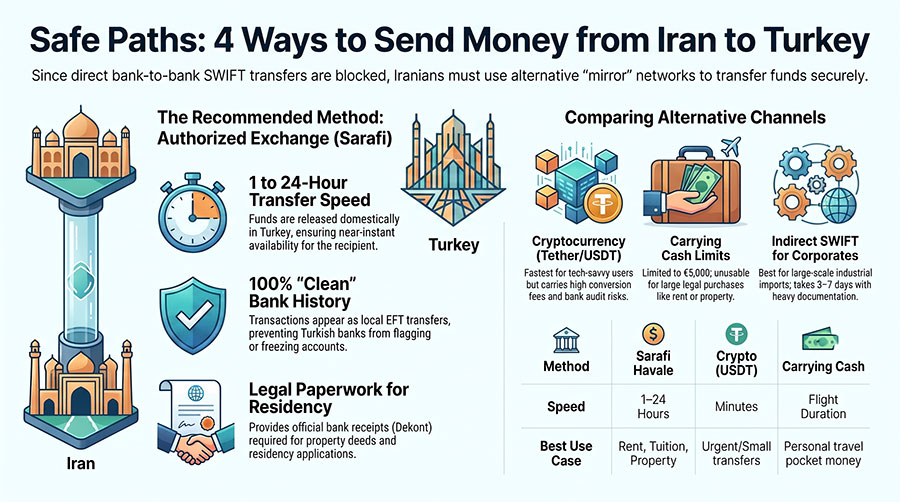
Yes, Iran can send money to Turkey, and the fastest, most reliable method is utilizing a specialized Exchange Office (Sarafi). Since direct bank-to-bank wire transfers are impossible due to sanctions, authorized providers like Sarafi Havale (Ahmadiyani) serve as the necessary financial bridge.
This method is not just fast; it is instant in many cases. When you work with a professional Sarafi, the transaction utilizes a system of internal clearing. You deposit Rials into the exchange’s verified corporate account in Iran. Simultaneously, the exchange office’s branch or partner in Turkey releases the equivalent amount in Lira, Dollars, or Euros directly to your Turkish bank account. There is no waiting for international clearance, and the funds typically arrive within a few hours. For anyone asking “can Iran send money to Turkey” with urgency, this direct remittance model is the industry standard.
Learn More About Sending Money to Turkey

To navigate these financial waters safely, it is important to understand the infrastructure. The global banking system relies on the SWIFT network to communicate and move funds. Iranian banks are currently disconnected from this network. Therefore, you cannot simply log into your Iranian mobile banking app and send money to a Ziraat or Ish Bank account in Istanbul.
This disconnection has created a “grey” but legal ecosystem for financial transfers. While the official banking doors are closed, the private sector has constructed robust alternatives. These range from digital assets like Cryptocurrency to traditional commercial exchange networks known as “Havale.” Each method has distinct advantages regarding speed and distinct risks regarding security. Understanding these differences is vital because choosing the wrong method can lead to blocked bank accounts in Turkey or loss of funds. Similar cross-border constraints exist in other regions as well, such as how to send money from iran to pakistan, where informal settlement networks are also the primary solution. This guide covers the practical details of every available option.
Best Methods to Transfer Money from Iran to Turkey

There is no “one size fits all” solution. The best method depends entirely on your specific needs, whether you are sending small pocket money or purchasing real estate. The five primary channels are:
- Transfer via Authorized Exchange Offices (Recommended)
- Transfer via Cryptocurrency (Tether/USDT)
- Carrying Cash (Passenger Limits)
- Western Union & MoneyGram (Intermediary Method)
- Indirect Banking (SWIFT via Third Countries)
Below, we explain each method in detail, providing the technical insights you need.
1. Transfer via Authorized Exchange Offices (Recommended)
Transferring through an authorized Sarafi is the most secure and professional method available. It effectively mimics a standard bank transfer but uses a private network. When clients ask “can Iran send money to Turkey” without risking their capital, this is the solution we advocate.
The Technical Process:
The operation is a “mirror transaction.” You do not physically send money across the border. instead, two separate domestic transfers happen simultaneously. First, you agree on a rate with Sarafi Ahmadiyani. You transfer Rials via the Iranian banking system (using Satna or Paya) to the Sarafi’s official account. Once the Rials are confirmed, the Sarafi uses their liquidity in Turkey to transfer Lira or foreign currency to your Turkish IBAN.
Why It Is Safe for Your Account:
Turkish banks are increasingly strict about “Anti-Money Laundering” (AML) compliance. They monitor incoming funds closely. If you deposit cash at a teller, the bank often flags the account for suspicious activity. However, when you use a reputable Sarafi, the money enters your account as a domestic bank transfer (Havale/EFT) from a registered company or a trusted financial trader. To the bank’s compliance algorithms, this looks like a legitimate local transaction, significantly reducing the risk of your account being frozen.
The Importance of the Receipt (Dekont):
One major advantage of this method is the paperwork. You receive a formal bank receipt (Dekont) for the transaction. If you are applying for residency or citizenship by investment, the Turkish government requires proof that the funds entered the country legally and through the banking system. Only a Sarafi transfer provides the valid paper trail required by the Tapu (Title Deed) office.
2. Transfer via Cryptocurrency (Tether/USDT)
Cryptocurrency has become a popular alternative for those who prefer digital autonomy. If you need to know “can Iran send money to Turkey” at 3:00 AM on a Friday, crypto is the only method that works outside of business hours.
The Operational Workflow:
The user purchases Tether (USDT)—a stablecoin pegged to the US Dollar—on an Iranian exchange platform. These funds are then moved to a personal, non-custodial wallet (like Trust Wallet or Exodus). From there, the user sends the USDT to a recipient in Turkey or an exchange office.
Hidden Risks and Practical Challenges:
While the transfer is instant, converting crypto to spendable cash in Turkey is the hard part. You must find a physical exchange shop (often found in the Grand Bazaar or Fatih district) to sell your USDT for Lira or Dollars. These shops charge a commission. Furthermore, Turkish banks are wary of crypto-related transactions. If you sell crypto on a Turkish online exchange (like Paribu) and immediately withdraw a large sum to your bank, it may trigger an audit. Additionally, users must be extremely careful with IP addresses; logging into major global exchanges from Iran without a secure VPN can result in the immediate confiscation of all assets.
According to safeheron:
The liquidity of USDT is crucial in the market, but it may be insufficient in certain extreme situations, such as large-scale redemptions or market panics. For instance, during the Silicon Valley Bank crisis in 2023, USDT briefly de-pegged to 0.95 US dollars, showing its vulnerability in extreme market conditions. Moreover, if the reserve assets of USDT (such as US Treasury bonds) experience market fluctuations, it could also affect its liquidity.
3. Carrying Cash (Passenger Limits)
Carrying physical cash is the most traditional method, but it is no longer suitable for modern life or large expenses. It is viable only for tourists needing pocket money.
Customs and Legal Limits:
Travelers must be aware of strict regulations. Exiting Iran, passengers are typically limited to carrying €5,000 (air travel) per person. Entering Turkey, there is technically no limit, but you must declare amounts over €10,000 to customs officers. Failure to declare this money can lead to its confiscation and heavy fines.
The “Unusable” Cash Problem:
Even if you successfully bring cash into Turkey, you may find it hard to use. You cannot buy a house or a car with a suitcase of cash in Turkey anymore. Laws require these transactions to go through banks to prevent tax evasion. Depositing a large amount of foreign cash into a Turkish bank account is also difficult; the bank will demand proof of origin. If you cannot prove where the cash came from, they may refuse the deposit. Therefore, while you technically *can* bring cash, it often creates more problems than it solves.
4. Western Union & MoneyGram (Is it possible?)
Global remittance giants like Western Union do not have branches in Iran. However, some local agencies offer a “proxy” service using intermediaries.
How the Intermediary Works:
You pay Rials to an office in Tehran. They contact a partner in a third country (like the UAE or Georgia). That partner sends the funds via Western Union to Turkey. The recipient in Turkey then visits a branch to pick up the cash.
Why We Do Not Recommend This:
The cost is prohibitive. You lose money on the exchange rate from Rial to Dirham, and then again from Dirham to Lira/Dollar. On top of that, you pay high commission fees. This method is slow, expensive, and generally only useful for emergency situations where the recipient has no bank account and needs cash immediately to buy food or a ticket.
5. Indirect Banking (SWIFT via Third Countries)
This method involves routing funds through a complex web of shell companies in free trade zones to bypass sanctions. It is primarily used for large-scale industrial imports, not personal transfers.
The Reality for Individuals:
This is not a viable solution for the average person asking “can Iran send money to Turkey.” The minimum transfer amounts are high (often above $50,000 or $100,000). The process takes 3 to 7 working days, and the compliance paperwork is exhausting. You must prove the commercial nature of the transaction. For rent, tuition, or living costs, this method is overly complicated and slow.
Comparison Table of Transfer Methods
To assist in your decision-making, we have compiled a comparison based on the factors that matter most: speed, security, and cost.
| Method | Speed | Security | Cost efficiency | Best Use Case |
| Sarafi Havale (Ahmadiyani) | 1 – 24 Hours | High (Bank Integration) | High (Market Rates) | Rent, Tuition, Property, Trade |
| Cryptocurrency | Instant | Medium (Tech Risks) | Medium (Conversion Fees) | Small amounts, Tech-savvy users |
| Carrying Cash | Flight Duration | Low (Theft/Customs) | High (Zero Fees) | Tourist spending money |
| Western Union Proxy | 1 – 3 Days | Medium | Low (High Fees) | Emergencies without bank accounts |
| Indirect SWIFT | 3 – 7 Days | High | Low (High Fees) | Large Corporate Imports |
Required Documents for Money Transfer (KYC)

Financial security relies on identity verification. Legitimate exchange offices operate under strict “Know Your Customer” (KYC) protocols to prevent fraud. When you ask “can Iran send money to Turkey” through a professional channel, providing documentation is a sign of safety, not bureaucracy.
Standard Requirements for Sarafi Havale:
To initiate a transfer with Sarafi Ahmadiyani, you will generally need to provide:
- Identity Verification: A clear picture of your National ID card.
- Bank Ownership Proof: A photo of the bank card you are using to transfer the Rials. This ensures the money is coming from your own account and not a stolen card.
- Recipient IBAN: The 26-digit Turkish IBAN starting with “TR”.
- Recipient Name: The full legal name of the account holder in Turkey.
Note that for personal transfers (living expenses, tuition), you do not need to provide tax returns or source-of-fund documents to the Sarafi. The internal KYC check is sufficient. If a dealer agrees to send money without asking who you are, they are likely operating illegally, which puts your money at risk of seizure.
Fees and Transfer Limits
Understanding the cost structure and volume limits is essential for planning your finances. The costs in the Sarafi system are different from western banks.
How Fees Work (The Spread):
Exchange offices rarely charge a separate “transaction fee” for standard amounts. Instead, the profit is generated through the exchange rate “spread.” This is the difference between the price the Sarafi buys currency at and the price they sell it to you.
Practical Tip: Always compare the final amount of Lira/Dollars you will receive, rather than just asking about the fee. A Sarafi might claim “zero commission” but offer a poor exchange rate.
Banking Limits in Iran:
The restriction on how much you can send usually comes from the Iranian banking side.
Card to Card: Limited to a small amount daily (e.g., 10 million Tomans).
Satna/Paya: These interbank systems allow for larger transfers (e.g., 100 to 200 million Tomans per day per IBAN).
For large property purchases, you may need to visit your bank branch in Iran to authorize a transfer of billions of Rials to the Sarafi’s account. Sarafi Ahmadiyani has the capacity to handle high-volume liquidity once the Rials are successfully moved within Iran.
Paying Tuition and Rent in Turkey
Two of the most critical payments for Iranians in Turkey are education and housing. These sectors have specific requirements that you must follow to avoid legal trouble.
Paying University Tuition:
Universities in Turkey (both public and private) generally refuse cash payments for tuition. They require direct bank transfers. When sending money for tuition:
1. Obtain the university’s official IBAN.
2. Crucial Step: Ask the Sarafi to write the Student Name and Student ID Number in the “Description” (Aciklama) field of the transfer. Without this, the university finance department cannot assign the payment to your profile, leading to registration delays.
Paying Rent:
Turkish law is increasingly mandating that rent be paid via bank transfer to track taxes. Paying cash to a landlord is risky because you have no proof of payment.
1. Transfer the exact rent amount via Sarafi Havale.
2. Request the specific transaction receipt (Dekont) from the Sarafi.
3. Send a screenshot of this receipt to your landlord via WhatsApp or Email immediately. This creates a digital paper trail that protects you from eviction claims or disputes over unpaid rent.
Security & Sanctions: Will My Account Get Blocked?
The fear of having a bank account frozen is the primary anxiety for Iranians abroad. The question “can Iran send money to Turkey” is often followed by “will Ziraat Bank close my account?”
The Root Cause of Blocked Accounts:
Turkish banks are not closing accounts simply because the holder is Iranian. They close accounts due to “suspicious flows.” If you regularly deposit large sums of cash via ATM or teller without a clear source of income in Turkey, the compliance software flags you. The bank assumes this might be money laundering or illicit trade.
How Sarafi Havale Protects You:
Using a professional Sarafi like Ahmadiyani mitigates this risk significantly. A similar risk-mitigation approach is also used in other corridors, including how to send money to iran from uae, where compliance concerns play a major role. When we process a transfer, the funds arrive in your account via a local bank transfer (EFT/Havale) from a registered trading company or a trusted financial entity within Turkey. To the bank’s system, this appears as a normal domestic transaction. It establishes a “clean” history for your account. It is far safer to receive a monthly transfer from a Sarafi than to walk into a branch with a pocket full of cash every month.
Why Choose Sarafi Havale (Ahmadiyani)?
In a market filled with options, reliability is the most valuable currency. Sarafi Havale (Ahmadiyani) has established itself as a dedicated specialist in the Iran-Turkey financial corridor.
We do not just move money; we provide peace of mind. Our team offers the most competitive exchange rates for Lira, Dollar, and Euro transfers, updated minute-by-minute. We understand the specific banking challenges Iranians face in cities like Istanbul, Antalya, and Izmir.
Our key strength is our infrastructure. With instant settlement capabilities, we ensure your rent or tuition is paid on time, every time. We offer full support and transparency, providing you with the necessary receipts to navigate Turkish bureaucracy. You no longer need to worry about the complexities of sanctions. With Sarafi Ahmadiyani, the answer to “can Iran send money to Turkey” is a simple, secure, and professional “Yes.”
Conclusion
While the political and economic landscape remains complex, the financial pathway between Iran and Turkey is open and functioning. You are not cut off from your capital. By understanding the limitations of the banking system and utilizing the robust alternatives available, you can manage your finances effectively. Can Iran send money to Turkey? Absolutely. The key is to avoid risky methods like carrying excessive cash or using unknown intermediaries. Instead, rely on the proven, secure, and legal framework of authorized exchange offices. If you are transferring funds in the opposite direction, you can also review Send Money from Turkey to Iran to understand how the same Sarafi infrastructure works in reverse. Sarafi Ahmadiyani stands ready to assist you with fast transfers, fair rates, and the security your money deserves. Contact us today to check the daily rate and secure your transfer.
Frequently Asked Questions
Is it legal to use a Sarafi to send money to Turkey?
Yes, utilizing an authorized Exchange Office (Sarafi) is a recognized and legal method of remittance in both Iran and Turkey. It operates under the “Havale” system, which creates a domestic transfer in Turkey, complying with local banking regulations.
What information do I need to give the Sarafi?
You typically need to provide your valid identification (National ID), a photo of your Iranian bank card for verification, and the recipient’s full details in Turkey: Full Name, IBAN (TR number), and Bank Name.
Can I buy a house in Turkey using this method?
Yes. In fact, this is the preferred method. For property purchases, you need a transaction receipt (Dekont) to prove the funds were transferred through the banking system. A Sarafi can transfer the funds directly to the seller or your account and provide this essential document.
How fast will the money arrive in my Turkish account?
With Sarafi Ahmadiyani, transfers are typically processed within 1 to 24 hours. Because the transfer happens domestically within Turkey (from the Sarafi’s Turkish account to yours), it avoids the multi-day delays of international SWIFT wires.
Why is the exchange rate different from the Google rate?
The rate you see on Google is the “mid-market” rate, often used for data, not trading. Exchange offices have operational costs and market fluctuations to account for. The “spread” (difference) covers the cost of the transfer service, which is why the operational rate differs slightly from the raw data rate.