
 فارسی
فارسی
 english

Sending funds internationally from Iran is a significant challenge due to strict banking sanctions and disconnected financial networks. Many people struggle to find a working channel and often face rejected transactions or frozen accounts. However, commerce and travel between Iran and Kenya are active, creating a daily need for secure transfers. This article explains the practical solutions available today, focusing on methods that bypass these barriers efficiently. Here is exactly what you will read in this guide.
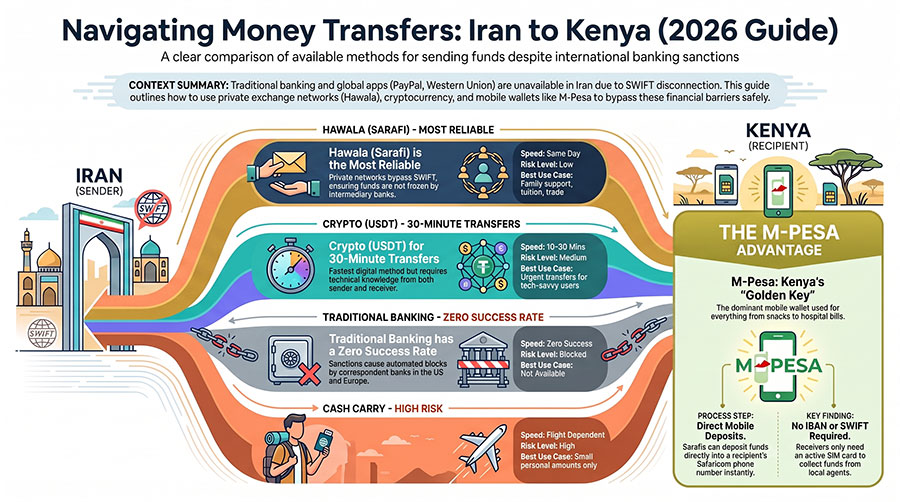
| Method | Speed | Risk Level | Best Use Case |
|---|---|---|---|
| Sarafi (Hawala) | Same day – 1 business day | Low | Family support, tuition, trade payments |
| Cryptocurrency (USDT) | 10–30 minutes | Medium | Tech-savvy users, urgent transfers |
| Cash Carry | Flight dependent | High | Small personal amounts only |
How to Send Money from Iran to Kenya (Sarafi Ahmadyani Services)
The most direct answer to your problem is to use a private exchange office rather than a commercial bank. If you are asking how to send money from Iran to Kenya without the risk of blocked funds, Sarafi Ahmadyani provides the most reliable solution. We act as a financial bridge that connects the Iranian banking network with the Kenyan financial system, allowing you to bypass the international restrictions that usually stop these transactions.
When you use our services, you are not relying on the SWIFT network, which is currently closed to Iran. Instead, you rely on a private network of liquidity that we maintain in both Tehran and Nairobi. This ensures that your transfer is treated as a local transaction on both ends, rather than an international wire that triggers compliance alarms. We have optimized this process to be as simple as a local card transfer.
Our specialized services include:
- Direct M-Pesa Deposits: We transfer funds directly to the receiver’s mobile wallet, which is the standard payment method in Kenya.
- Cash Pickup in Major Cities: If the receiver prefers physical cash, they can collect it from our partners in Nairobi, Mombasa, and Kisumu.
- Optimized Exchange Rates: We monitor the market to give you the best possible conversion from Rial to Kenyan Shilling (KES).
- Security Guarantee: We insure your funds from the moment you deposit Rials until the moment the receiver gets Shillings.
You can contact our support team via WhatsApp today to get a real-time quote. We are here to demonstrate how to send money from Iran to Kenya is simple when you have the right partner.

Know More About Sending Money from Iran to Kenya
To navigate this process successfully, it is helpful to understand the context of the financial relationship between these two nations. Iran and Kenya have a robust trade relationship. Kenya is a vital economic hub in East Africa and is the primary supplier of tea to the Iranian market. In exchange, Iranian companies export construction materials, bitumen, and petrochemical products to Kenya. Additionally, a growing number of Iranian students are enrolling in Kenyan universities for medical and technical degrees, creating a constant need for tuition and living expense transfers.
However, the financial infrastructure does not support this activity. The core problem is the disconnection of Iranian banks from the global SWIFT messaging system. Standard money transfer apps that are popular globally, such as Western Union, PayPal, and WorldRemit, do not operate in Iran. If you try to access these platforms from Tehran, your IP address will likely be blocked, and you cannot link an Iranian bank card to them. This creates a situation where you have the money, but no digital highway to move it. This is why specialized Sarafis are essential. If you are looking for a broader overview of outbound transfers, read how to send money from iran to other countries. They provide the necessary infrastructure to ensure that families can support their children and businesses can pay their suppliers despite the sanctions.

Best Methods for Money Transfer to Kenya
In 2026, you must be realistic about which financial channels are actually open. You cannot walk into a branch of Bank Melli and request a wire transfer to Equity Bank in Nairobi. That path is blocked. To successfully transfer funds, you must use alternative financial rails that are independent of Western banking pressure.

Here are the only three proven methods on how to send money from Iran to Kenya:
- Transfer via Trusted Exchange Offices (Hawala)
- Cryptocurrency and Tether (USDT) Transfer
- Cash Delivery (Hand-Carry)
A similar transfer structure is used for South Asia, which is explained in how to send money from iran to india.

Transfer via Trusted Exchange Offices (Hawala)
The Hawala system is the most recommended method for the majority of our clients. It is efficient, secure, and requires zero technical knowledge from the sender. When you choose to send money through Sarafi Ahmadyani, you are utilizing a system based on “offsetting balances.” You transfer the required amount in Iranian Rials to our local bank account in Iran. Once we confirm receipt, we instruct our partner office in Nairobi to pay the equivalent amount in Kenyan Shillings to your designated receiver.
The beauty of this system is that no money physically crosses the border. We simply adjust the ledgers between our office in Iran and our partner in Kenya. This means there is no international wire transfer to be intercepted or frozen by an intermediary bank in New York or Europe. For you, the user, the process is seamless. It offers peace of mind because you are dealing with a registered entity that guarantees the transaction. If for any reason the money does not reach the receiver, the Sarafi is liable to refund you. This level of accountability is why Hawala remains the primary answer for how to send money from Iran to Kenya.
Cryptocurrency and Tether (USDT) Transfer
For those who are comfortable with modern technology, cryptocurrency offers a digital alternative. This method utilizes blockchain technology, which operates independently of central banks. The most practical digital asset for this purpose is Tether (USDT), which is a “stablecoin” pegged to the value of the US Dollar.
The process involves the sender in Iran purchasing USDT from a local crypto exchange using Rials. The sender then transfers this USDT to the digital wallet of the receiver in Kenya. The receiver must then use a peer-to-peer (P2P) platform, such as Binance or Paxful, to sell the USDT in exchange for Kenyan Shillings. While this method is fast and available 24/7, it places a burden on the receiver. If you want to compare this with a North American corridor, see how to send money from iran to usa. They must know how to set up a wallet, how to receive crypto, and how to sell it safely without getting scammed. If the receiver is not tech-savvy, this method can be stressful and prone to user error.
According to safeheron:
The value of USDT relies on the claim by its issuer, Tether Ltd., that it is backed by a 1:1 reserve of US dollars. However, the transparency of Tether’s reserve assets has long been questioned. Although Tether asserts that each USDT is supported by corresponding US dollars or other assets, the majority of its reserves are not in cash but in commercial papers, loans, and other assets. This means that in the event of large-scale redemptions, Tether may not be able to fully honor all USDTs, leading to a potential de-pegging from the US dollar.
Cash Delivery (Hand-Carry)
The most traditional method involves physically carrying cash, usually US Dollars or Euros, on a flight from Tehran to Nairobi. This is typically done by tourists, pilots, or business owners who travel frequently between the two countries.
While this might seem straightforward, it is fraught with risks. First, there is the physical risk of theft or loss during the journey. Second, and more importantly, there are strict customs regulations. You are generally required to declare any cash amount exceeding $10,000 (or its equivalent) to customs authorities. Failure to do so can result in the confiscation of your money. Additionally, you are limited by flight schedules. You cannot send money urgently if no one is traveling. We advise using this method only for small, personal amounts carried by the owner themselves.
Receiving Money via M-Pesa in Kenya (Special Guide)
If you are researching how to send money from Iran to Kenya, you must familiarize yourself with M-Pesa. In Kenya, M-Pesa is more than just an app; it is the dominant financial system. Launched by Safaricom, it allows users to store and transfer money using their mobile phones. It is so pervasive that you can use it to pay for everything from a roadside snack to a hospital bill.
For our Iranian clients, M-Pesa is the golden key to successful transfers. Unlike bank accounts, which can be difficult to open for foreigners or strict about incoming funds, almost every Kenyan adult has an M-Pesa account linked to their SIM card. When you use Sarafi Ahmadyani, we can deposit funds directly into this system. You do not need the receiver’s IBAN or SWIFT code. You simply provide their Safaricom phone number.
The transfer is typically instant. The receiver gets an SMS notification confirming the credit. They can then visit any “M-Pesa Agent”—small shops found on almost every street corner in Kenya—to withdraw cash, or they can keep the money digital to pay bills. This ease of access makes M-Pesa the superior choice for supporting students or sending family remittances.
Challenges of Banking Transfer to Kenya

It is natural to wonder why you cannot simply use the traditional banking system. The reason lies in the complex web of global compliance. International money transfers do not move directly from Bank A to Bank B. They pass through “correspondent banks” or “intermediary banks,” which are usually large financial institutions based in the US or Europe.
These intermediary banks are legally bound by sanctions and FATF (Financial Action Task Force) regulations. They use automated software to scan every transaction. If a transfer originates from Iran, it is immediately flagged and blocked. Even if a local Kenyan bank is willing to accept your money, the intermediary bank will stop the transaction before it ever reaches Kenya.
Furthermore, Kenyan banks themselves are becoming increasingly risk-averse. If a Kenyan business account receives a direct wire from a sanctioned jurisdiction, the bank may freeze the account to protect its own international banking relationships. This can cause massive legal headaches for the receiver. Therefore, attempting a direct bank wire is not a viable solution for how to send money from Iran to Kenya. It is slow, expensive, and has a near-zero success rate.
Important Factors for Money Transfer to Kenya
When you are ready to make a transfer, there are specific details you should monitor to ensure you get the best deal. Understanding these factors will help you manage your expectations and costs.
- Exchange Rates and Conversion Logic
There is no direct trading market for the Iranian Rial against the Kenyan Shilling. To determine the rate, we use a “cross-rate” calculation. First, we determine the value of your Rials in a hard currency, such as the US Dollar or UAE Dirham. Next, we convert that dollar value into Kenyan Shillings based on the rate in Nairobi. Because there are two conversions involved, the rate might be slightly different from what you see on Google. At Sarafi Ahmadyani, we strive to keep this margin as low as possible. - Service Fees
Unlike a bank that might charge a flat wire fee, exchange offices build their fee into the exchange rate or charge a small percentage. This fee covers the operational costs of maintaining offices in two countries and the risk management involved in bypassing sanctions. Always ask for the “final amount” the receiver will get to ensure transparency. - Transaction Speed
Speed varies by method. M-Pesa transfers are usually completed within an hour during business days. Bank deposits in Kenya can take 1 to 3 working days because they must go through the local clearing house. If the matter is urgent, always prioritize M-Pesa.
Step-by-Step Guide to Transfer Money

We have streamlined the transfer process to be as intuitive as possible. You do not need to be an expert in finance to use our services. Follow this simple guide.
- Contact Us for a Quote:Reach out to Sarafi Ahmadyani via WhatsApp or Telegram. Tell us exactly how much you want to send (in Rials) or how much you want the receiver to get (in Shillings). We will provide a valid exchange rate for that hour.
- Submit Receiver Details:Accuracy is key. Provide the receiver’s full legal name. If sending to M-Pesa, provide their mobile number (e.g., +254 7…). If sending to a bank, provide the Bank Name, Branch, and Account Number.
- Deposit Rials:We will provide you with a secure Iranian bank card number. You can transfer the Rials using your mobile banking app, internet banking, or a local ATM.
- Send the Receipt:Take a screenshot or photo of the transaction receipt and send it to us.
- Confirmation:Once we verify the deposit, our Nairobi team releases the funds. We will send you a final transaction receipt which you can share with the receiver.
Comparison of Transfer Methods
To assist you in making the best decision, we have created a comparison of the three primary methods. This table highlights why the Sarafi option is generally the most balanced choice for reliability and ease.
| Feature | Sarafi (Hawala) | Crypto (USDT) | Traditional Bank |
| Speed | Very Fast (Same Day) | Instant Transfer | Weeks (or Rejected) |
| Reliability | High (Guaranteed) | Medium (User Dependent) | Zero (Blocked) |
| Convenience | High (Full Service) | Low (Requires Tech Skill) | Low (High Paperwork) |
| M-Pesa Integration | Direct Deposit | Indirect (Must Sell) | No |
| Risk of Loss | None (Insured) | Medium (Hacking/Error) | High (Freezing) |
The data clearly shows that for a user seeking a hassle-free experience, the Sarafi route is superior. It eliminates the technical complexity of crypto and the regulatory walls of traditional banking.
Conclusion
Navigating international finance from a sanctioned country can be daunting, but it is not impossible. While the doors of traditional banking are closed, the specialized corridors provided by professional exchange offices remain open and secure. Understanding how to send money from Iran to Kenya is simply a matter of choosing the right service provider.
Sarafi Ahmadyani offers a solution that is fast, secure, and tailored to the specific needs of Iranians. Whether you are paying for commercial imports, supporting a student in Nairobi, or sending a gift to a friend, our M-Pesa and Hawala services ensure your money arrives safely. Do not let political barriers hinder your financial needs. Contact us today to experience a seamless transfer process.
Frequently Asked Questions (FAQ)
Is it safe to send large amounts via Sarafi?
Yes, reputable Sarafis operate on a reputation-based system and often have significant capital reserves. For very large commercial amounts, we may split the transfer into smaller tranches or use direct bank deposits in Kenya to ensure safety and compliance with local limits.
What if the receiver does not have an M-Pesa account?
While M-Pesa is standard, it is not mandatory. We can also deposit funds into any Kenyan bank account (like Equity, KCB, or Co-operative Bank). However, please note that bank deposits may take 24 to 48 hours to clear, whereas M-Pesa is instant.
Can I send money from Kenya back to Iran?
Yes, the Hawala system is bidirectional. If you are a business owner in Kenya needing to pay a supplier in Tehran, or a worker sending savings home, we can accept Shillings in Nairobi and deposit Rials into an Iranian bank account quickly.
How do I verify the current exchange rate?
The exchange rate fluctuates daily based on the global market. The best way to verify the rate is to message our support team directly. We provide a locked-in rate for your transaction at the time of your inquiry, so you know exactly how much to pay.
What details do I need for an M-Pesa transfer?
You only need two things: the receiver’s official name (as registered with Safaricom) and their mobile phone number. It is crucial to double-check the phone number, as M-Pesa transactions are fast and can be difficult to reverse if sent to the wrong person.