
 فارسی
فارسی
 english

Transferring funds between Iran and India is a complex task due to strict international banking sanctions and financial regulations. If you need to know How to Send Money from Iran to India, you cannot rely on standard banking methods like SWIFT or simple card-to-card transfers. You must navigate a landscape of specialized brokers, digital currencies, and specific customs rules. This guide provides a complete, step-by-step explanation of the safe, legal, and efficient methods available in 2025. Many users face similar restrictions when moving funds in the opposite direction, especially when learning how to send money from india to iran under international sanctions. By the end of this article, you will understand exactly which method suits your needs, whether you are a student, a trader, or supporting family.
| Method | Best For | Speed | Safety Level | Key Risk |
|---|---|---|---|---|
| Licensed Sarafi | Tuition, family support, large transfers | Same day – 2 days | High–Very High | Delay or review even with documents |
| Cryptocurrency (USDT) | Emergency, tech-savvy users | Minutes–hours | Medium | User error, off-ramp freeze |
| Physical Cash | Travel, small needs | Flight time | Low–Medium | Seizure, loss, declaration limits |
| Traditional Hawala | ❌ Not recommended | Fast | Very Low | Account shutdown, fraud |
| Direct Bank Transfer | ❌ Impossible | — | — | Structurally blocked by sanctions |
Sending Money to India with Sarafi Ahmadiyani
The most direct, secure, and professional answer to How to Send Money from Iran to India is utilizing the services of Sarafi Ahmadiyani. This is not just a general recommendation; it is the most practical solution for avoiding the legal and financial risks associated with international sanctions.
Sarafi Ahmadiyani distinguishes itself by specializing in the Rupee (INR) corridor. While many exchanges only offer US Dollars or Euros, this firm has established direct settlement channels within India. This means you do not have to worry about converting currencies multiple times. You pay in Rials (IRR) in Iran, and the beneficiary receives Rupees in their Indian bank account. This direct route minimizes exchange rate losses and significantly increases the speed of the transaction.

Why This Service is the Safest Option
In the current financial climate of 2025, the safety of the receiver’s bank account is paramount. Using random exchangers or unknown individual traders can put the Indian bank account at risk of being flagged for suspicious activity. Sarafi Ahmadiyani operates with a level of professionalism that prioritizes the “cleanliness” of the funds. Here are the specific benefits for the user:
- Risk Mitigation: They ensure that the funds deposited into the Indian account come from legitimate banking sources, preventing account freezes.
- Speed: Transfers are often completed on the same day or instantly via IMPS (Immediate Payment Service).
- Support for Students: They understand the urgency of university deadlines and can provide transaction receipts (UTR numbers) required by college administrations.
- Transparency: There are no hidden fees. The rate is agreed upon upfront, and you receive exactly what was promised.
By choosing a specialized broker like Ahmadiyani, you are effectively bypassing the sanctions wall through a legal and secure financial bridge.

Know More About Money Transfer to India
To fully grasp How to Send Money from Iran to India, you must understand the technical barriers preventing normal transactions. The global banking system relies on a messaging network called SWIFT. Due to FATF (Financial Action Task Force) restrictions and US sanctions, Iranian banks are disconnected from this network. This means a direct wire transfer from Bank Melli to the State Bank of India is technically impossible. The computers simply cannot talk to each other.
Consequently, all money transfers must move through “intermediary” channels. These are third-party hubs located in neutral financial zones (like Dubai) or decentralized networks (like Blockchain). When you ask how to send money from Iran to India, you are essentially asking which intermediary is the safest to use. The same intermediary-based logic also applies to other major corridors, such as cases where families need to send money from iran to uk.
The Three Valid Pathways
Currently, there are only three ways to move value across this border:
- Exchange Brokers (Sarafi):Licensed entities that balance ledgers in both countries. This is the “White” or “Grey” channel depending on documentation, but it is the safest for the user.
- Cryptocurrency:Using Digital Dollars (USDT). This is the modern tech route but comes with significant regulatory baggage in India.
- Physical Cash:Carrying banknotes on a flight. This is the traditional route but is severely limited by customs laws.
- Informal Hawala (Dasti):The old method of trusted agents. This is fast but legally risky and lacks documentation.
Understanding these distinct paths is crucial because each carries a different level of risk for your money and your legal standing in India.

Best Methods for Transferring Money from Iran to India
Here is a detailed breakdown of the most effective methods. If you are researching How to Send Money from Iran to India, you should choose one of the following based on your specific needs regarding speed, cost, and safety.
- Exchange Remittance (Havaleh)
- Cryptocurrency (Tether/USDT)
- Cash (Physical transit)

| Method | Speed | Risk Level | Cost Efficiency | Best For |
| Exchange Remittance | 1 – 24 Hours | Low (Safe) | Medium | Tuition, Large Sums, Family Support |
| Cryptocurrency | Instant (Transfer) | High (Bank Freeze) | Low (Network Fees) | Tech-savvy users, Micropayments |
| Physical Cash | Flight Duration | Medium (Customs) | Variable | Tourists, Small emergency funds |
For 95% of users, especially students and families, the Exchange Remittance via a trusted partner like Sarafi Ahmadiyani is the superior choice. It offers the best balance of safety and reliability. While Crypto seems modern, the regulatory environment in India makes it a minefield for the uninitiated.
If you are dealing with North American routes as well, reviewing how people send money from iran to canada can help you compare safety and compliance differences.
Transfer via Cryptocurrency and Potential Risks
Many online guides will tell you that the easiest answer to How to Send Money from Iran to India is Cryptocurrency. While it is true that sending USDT (Tether) is instant, these guides often fail to mention the severe risks involved in converting that crypto to cash in India in 2025.
| Risk Area | What Happens | Consequence | Safer Alternative |
|---|---|---|---|
| P2P Buyer Fraud | Buyer linked to scam | Full bank account freeze | Broker-handled conversion |
| Wrong Wallet Address | Funds sent incorrectly | Permanent loss | Double-check + test transfer |
| Police Investigation | Funds traced via I4C | Months-long debit freeze | Sarafi backend settlement |
| Regulatory Uncertainty | Sudden rule changes | Account review or ban | Documented remittance route |

The “Bank Freeze” Phenomenon
This is the single most critical danger you must be aware of. In India, the Cyber Crime Coordination Centre (I4C) and local police forces are aggressively targeting Peer-to-Peer (P2P) crypto transactions. Here is the typical nightmare scenario:
- You transfer USDT from Iran to your wallet in India.
- You go to a P2P platform (like Binance or Bybit) to sell the USDT for Rupees.
- A buyer sends Rupees to your Indian bank account.
- The Problem:If that buyer was involved in any financial fraud or scam elsewhere, the police track the money to your account.
- The Consequence:The police place a “Debit Freeze” or “Lien” on your entire bank account. You cannot withdraw your funds, pay rent, or buy food.
Unfreezing an account can take months and may require you to hire a lawyer or travel to a different state in India. For a student or a trader, this is a catastrophic outcome.
The Safe Alternative
Does this mean you cannot use crypto? Not necessarily. It means you should not do the conversion yourself on public P2P markets. Instead, send your USDT to a professional broker like Sarafi Ahmadiyani. They handle the conversion on their backend using verified business accounts. They then deposit clean Rupees into your account. This method answers How to Send Money from Iran to India using crypto technology without exposing yourself to the police risks associated with P2P trading.
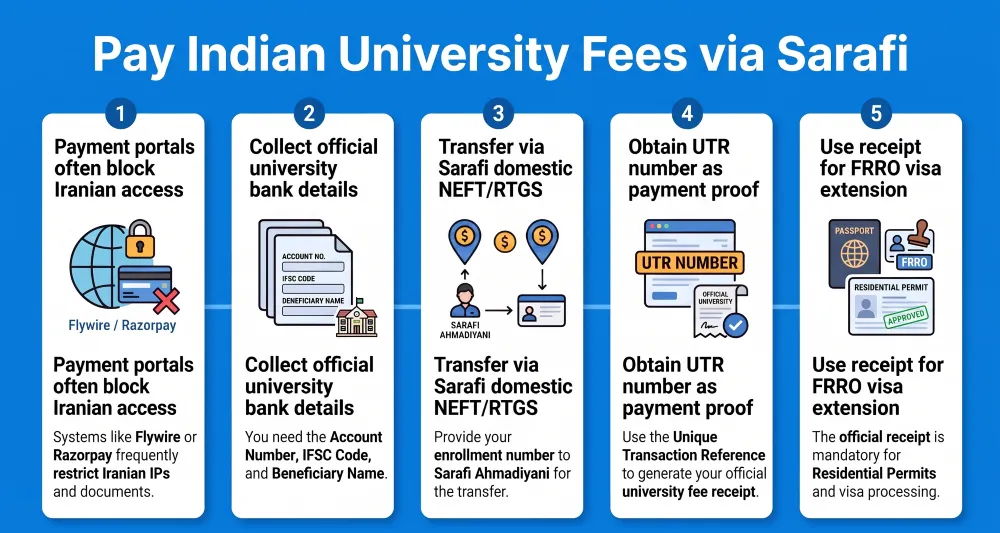
Paying Indian University Fees from Iran
For the thousands of Iranian students studying in India, the most pressing version of How to Send Money from Iran to India is paying tuition fees. Universities have become very strict and mostly digital.

The Obstacles
Most Indian universities now use automated payment portals like Flywire, Razorpay, or Easebuzz. These systems often block access from Iranian IP addresses. Furthermore, they require an Indian debit card, Net Banking, or a credit card, which Iranian students cannot obtain easily with their Iranian documents.
The Professional Solution
You can bypass this hurdle completely by using a Sarafi service. Here is the process:
- Step 1: Obtain the official bank account details of the university (Account Number, IFSC Code, Beneficiary Name).
- Step 2: Provide these details to Sarafi Ahmadiyani along with your Student Enrollment Number.
- Step 3: The Sarafi performs a domestic NEFT or RTGS transfer directly to the university.
- Step 4: You receive the UTR (Unique Transaction Reference) Number.
Crucial Tip: The UTR number is your proof of payment. You must take this number to the university’s accounts department to generate your fee receipt. This official fee receipt is mandatory when you apply for your Residential Permit or Visa Extension at the FRRO. Using a documented transfer ensures your visa process remains smooth.
Carrying Cash and Indian Customs Regulations
If you prefer to carry money physically, you must strictly adhere to Indian customs laws. Ignorance of these rules is not an excuse and can lead to confiscation of your hard-earned money.
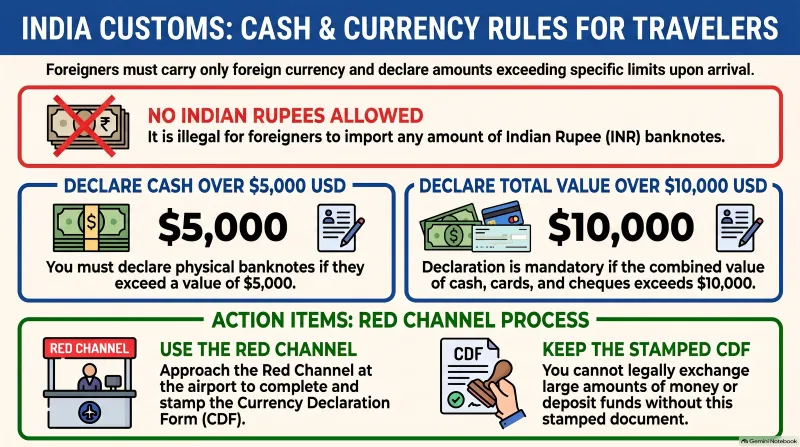
Rule 1: No Indian Rupees
It is illegal for any foreigner to import Indian Rupee (INR) banknotes into India. Do not buy Rupees in Tehran. If customs officers find Rupees in your luggage, they will seize them. You must strictly carry foreign currency like US Dollars (USD) or Euros (EUR).
embassyofindiabangkok says:
Import of Indian Currency is prohibited. However, in the case of passengers normally resident in India who are returning from a visit abroad, import of Indian Currency upto Rs. 7,500 is allowed.
Rule 2: Declaration Thresholds
You can bring as much foreign currency as you want, but you must declare it if it exceeds certain limits. The 2025 regulations state:
- $5,000 USD: If you are carrying more than $5,000 in physical cash notes, you must declare it.
- $10,000 USD: If the aggregate value (Cash + Forex Cards + Travelers Cheques) exceeds $10,000, you must declare it.
The CDF Form Procedure
To declare the money, you must approach the “Red Channel” at the arrival airport (e.g., IGI Airport in Delhi or CSMI in Mumbai) before you exit the customs area. Ask for the Currency Declaration Form (CDF). Fill it out accurately. The customs officer will stamp it and give it back to you.
Why is this important? When you go to a bank or money changer in the city to convert your dollars into rupees, they will ask for this stamped CDF if the amount is large. Without it, you cannot legally exchange the money, and you cannot deposit it into a bank account. Always keep this paper safe.
Traditional Hawala System Explained
Historically, the “Havaleh Dasti” (Manual Hawala) was the primary answer to How to Send Money from Iran to India. It operates on a system of trust and phone calls without any electronic wire transfers.
How it Works
You visit a merchant in the Tehran bazaar and hand over Rials. That merchant calls a partner in an Indian city like Mumbai, Hyderabad, or Bangalore. The Indian partner takes cash Rupees from their safe and delivers them to your contact’s doorstep or meets them at a specific location.
The Hidden Risks
While this method offers anonymity, it is fraught with risks in the modern era:
- Security: If the courier is robbed or simply disappears with your money, there is no insurance and no legal way to recover the funds.
- Arbitrary Rates: The exchange rate is often set by the agent on the spot, usually much higher than the market rate.
- Legal Danger: Carrying large amounts of unexplained cash in India is risky. If the police stop the courier or the receiver, they can confiscate the money under suspicion of tax evasion or money laundering.
Compared to the documented transfers offered by a professional Sarafi, the traditional Hawala system is outdated and unnecessarily risky for legitimate transactions.
Methods That Do Not Work for Iran
In your search for How to Send Money from Iran to India, you will encounter many global fintech apps. It is vital to know that these services do not work for Iranian citizens due to comprehensive sanctions.
PayPal
PayPal has a zero-tolerance policy for Iran. Do not try to open an account using a VPN or fake details. PayPal’s security algorithms are extremely sophisticated and will eventually detect the account linkage to Iran. Once detected, the account is permanently limited, and any funds inside are frozen indefinitely.
Wise (TransferWise) and Western Union
These platforms are obligated to follow US banking laws. They require Know Your Customer (KYC) verification, which involves uploading a passport and proof of address. They do not accept Iranian passports for account creation. Additionally, Western Union has no operational branches in Iran. Attempting to route money through friends in Europe to these services often triggers anti-money laundering blocks.
Tax Implications for Receiver in India
When you successfully find a way How to Send Money from Iran to India, you must also consider the tax consequences for the person receiving the funds. The Income Tax Department of India monitors high-value transactions.
Family Maintenance Exception
If the money is sent from a parent to a child for education or living costs, it is categorized as “Family Maintenance.” In India, gifts from “lineal ascendants” (parents/grandparents) are tax-exempt. However, the student should maintain a record of the transaction. If the amount is substantial (e.g., over 5-10 Lakh Rupees annually), it is wise to keep the transfer receipts.
Business Income and GST
If the money is payment for goods or services (exports), it is considered income. The Indian receiver must declare this in their Income Tax Return (ITR). Furthermore, if the money is routed through a Sarafi, the receiver should ask for a ledger confirmation or a clear narration in the bank statement to prove that the funds are for a legitimate trade deal. This prevents the funds from being taxed as “unexplained cash credits” which attract a flat 60% tax plus penalties.
Conclusion
Navigating the financial corridor between these two nations requires caution and knowledge. The question of How to Send Money from Iran to India has multiple answers, but only a few are safe in 2025. While sanctions have closed the front door of banking, professional services have built secure side doors.
Avoid the temptation of using high-risk P2P crypto platforms that endanger your bank account. Steer clear of blocked services like PayPal. Instead, rely on the proven reliability of Sarafi Ahmadiyani. Their ability to transfer funds directly into Indian bank accounts via domestic channels like NEFT/IMPS offers the perfect blend of speed, security, and peace of mind. Whether you are paying university fees or supporting loved ones, choosing a specialized and transparent broker is the smartest financial decision you can make.
FAQ
Is it legal to send money from Iran to India?
Yes. Personal transfers such as tuition payments, family support, and private remittances are legal when routed through compliant intermediaries like licensed Sarafi services.
What is the safest way to send money from Iran to India?
Using a specialized exchange such as Sarafi Ahmadiyani is the safest option. Funds are deposited into Indian bank accounts via NEFT/IMPS from clean, verifiable sources.
Can my Indian bank account be frozen?
Yes, if funds arrive via suspicious cash deposits or P2P crypto buyers. Using a Sarafi with proper receipts greatly reduces this risk.
Is cryptocurrency a good option?
Crypto is fast but risky in India. P2P conversions frequently trigger police-linked bank freezes. It is safer to let a broker handle the conversion.
How long does a Sarafi transfer take?
Most transfers are completed within a few hours to 24 hours. Student tuition payments are often processed the same day.