
 فارسی
فارسی
 english
Sending funds from Iran to the United States presents specific challenges due to banking regulations, but it is entirely possible with the right approach. You do not need to worry about impossible barriers, as legal channels exist for personal transfers. This guide explains the practical steps, safety measures, and latest methods available in 2026. We will cover everything from professional exchange services and cryptocurrency to compliance rules and avoiding common banking mistakes in this article.
| Method | Best Use Case | Speed | Risk Level | Key Notes |
|---|---|---|---|---|
| Professional Sarafi (Licensed Exchange House) | Tuition payments, family support, large transfers | 1–3 days | Very High (Reliability) | Clean banking trail, widely used under sanctions |
| Cryptocurrency (USDT) | Small, fast transfers | Minutes–hours | Medium | Requires technical knowledge & wallet security |
| Cash via Traveler | Emergencies only | Instant | Low (Scalability) | $10,000 legal limit, personal risk |
| Third-Party Banking | Legal indirect transfers | 1–3 days | High | Standard industry workaround |
| Direct Bank Transfer | — | — | — | ❌ Blocked by sanctions |
| PayPal / Western Union | — | — | — | ❌ Not available in Iran |
Sending Money from Iran to USA via Sarafi Ahmadyani
The most secure and efficient way to handle your transfer is through a specialized service provider. Sarafi Ahmadyani is dedicated to bridging the financial gap between these two nations. We understand that you need reliability, and our system is designed to provide exactly that.
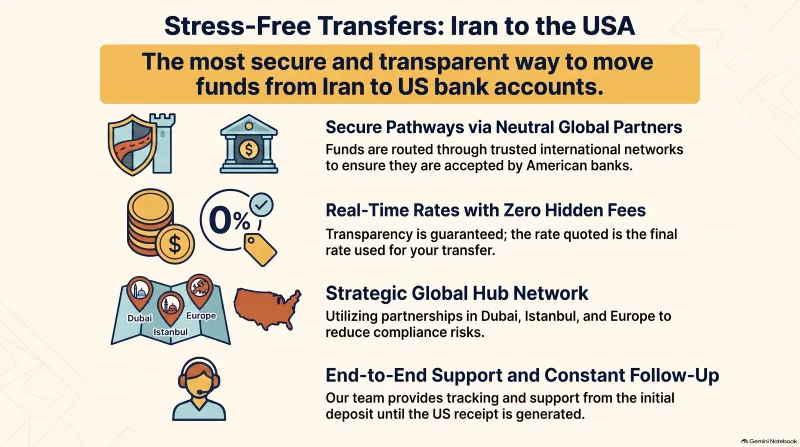
When you choose our service, you are not just getting a currency conversion; you are getting a secure financial pathway. We handle the complexities of the banking networks so you do not have to. Our team ensures that your funds move through trusted partners in neutral countries before arriving in the US, ensuring the transaction is clean and accepted by American banks.
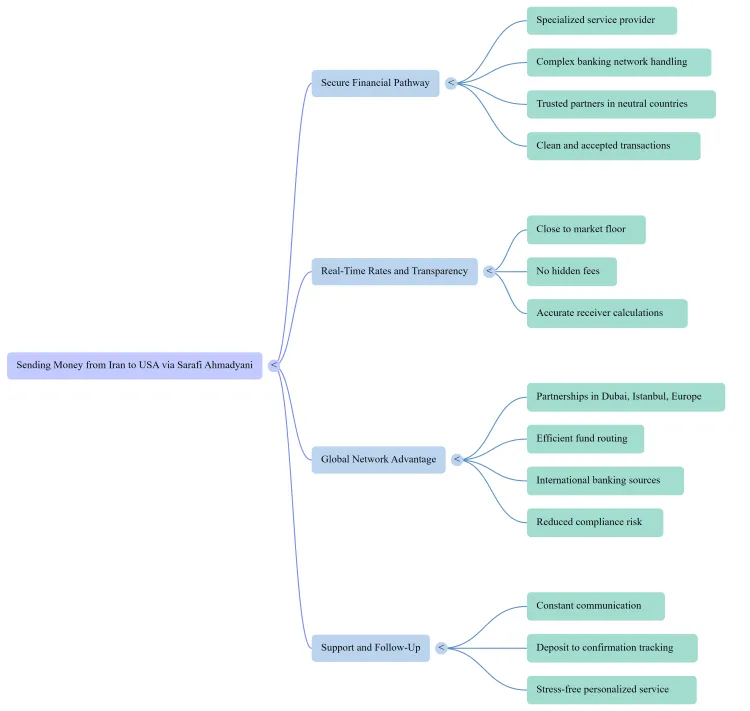
Real-Time Rates and Transparency
One of the main concerns customers have is the exchange rate. The market changes rapidly, and you want to ensure you get the best value for your Rial. At Sarafi Ahmadyani, we offer rates that are extremely close to the market floor. We believe in transparency. When you contact us, the rate we quote is the rate you get. There are no hidden fees that appear at the last minute. This allows you to calculate exactly how much your receiver in the US will get.
Our Global Network Advantage
Success in this industry depends on having a strong network. We have established solid partnerships in key financial hubs like Dubai, Istanbul, and various European cities. This network allows us to route your funds efficiently. When the money arrives in the US account, it comes from a recognized international banking source, which significantly reduces the risk of compliance issues.
Constant Support and Follow-Up
We know that waiting for a transfer can be stressful. You want to know where your money is at all times. Our service includes constant follow-up. From the moment you deposit funds in Iran to the moment the confirmation receipt is generated in the USA, our support team is available to answer your questions. We don’t leave you in the dark. If you are looking for how to send money from Iran to USA without stress, our personalized service is the answer.
Many families also face the same challenges when sending financial support in the opposite direction, such as learning how to send money to iran from usa safely and legally.
Contact us today to check the current Dollar rate and start your secure transfer.
Know More About Sending Money from Iran to USA
To navigate this process, you must understand the underlying mechanism. The banking systems of Iran and the United States are not directly connected. The SWIFT network, which allows banks to message each other, does not facilitate direct transfers between Tehran and US cities. Therefore, you cannot simply walk into an Iranian bank and wire money to a Bank of America account.
The solution lies in “Third-Party Transfers.” This is the industry standard and is used by thousands of people every month. The process involves a relay system. When you initiate a transfer, the physical money you pay in Iran stays in Iran. The money your receiver gets in the US is sent from a different account located in a third country, such as the UAE or a European nation. This separation is what makes the transfer possible.
Why Direct Transfers Are Impossible
Banking sanctions mean that US banks will automatically reject any direct instruction from an Iranian financial institution. Even if the technology existed to send the message, the compliance filters in the US would block the funds immediately. This is why a professional intermediary is necessary. The intermediary effectively swaps the debt, ensuring the US side of the transaction looks like a standard international wire from a friendly country.
This method is safe, provided you use a reputable provider. It relies on the liquidity and credit of the exchange service. Established services have deep pools of funds in multiple countries, allowing them to settle these transactions instantly. This ensures that when you ask how to send money from Iran to USA, the answer is a smooth, seamless process rather than a blocked bank wire.
The same third-party routing logic is commonly used for European corridors, including cases where users need to send money to iran from uk.
Best Methods for Money Transfer to USA (Quick Comparison)
Choosing the right method depends on your specific situation. Are you sending a large amount for tuition? Or a small amount for a birthday gift? Here is a breakdown of the three primary methods to help you decide.
| Feature | Professional Sarafi (Exchange) | Cryptocurrency (Tether/Bitcoin) | Traveler (Cash) |
| Primary Use | Large amounts, Tuition, Family Support | Small amounts, Tech-savvy users | Emergency cash, Travel expenses |
| Safety Level | High (Service Guarantee) | Medium (User Error Risk) | Low (Risk of Loss/Theft) |
| Speed | 1 to 3 Business Days | Minutes to Hours | Instant (Upon Arrival) |
| Complexity | Low (We do the work) | High (Requires Technical Skill) | Low (Physical Carry) |
| Dollar Limit | High Limits | Unlimited (Hard to Cash Out) | Max $10,000 per person |

Analysis of Options
The Professional Sarafi is the most balanced option for the general public. It offers the highest safety for significant amounts. If you are buying a property or paying for a full year of university, this is the only practical route. The paper trail is clean, and the risk of loss is minimal.
Cryptocurrency is excellent for speed but requires technical knowledge. If you send money to the wrong wallet address, it is gone forever. Also, cashing out large amounts of crypto in the US can trigger aggressive questions from banks.
Carrying Cash is the least recommended for large sums. It is dangerous to carry cash, and US Customs strictly enforces the $10,000 declaration rule. If you forget to declare it, they can seize the money. It is not a scalable solution for regular support.
For users dealing with North American transfers beyond the US, reviewing how to send money from iran to canada can help compare routes and compliance requirements.
Transfer via Cryptocurrency (Tether/Bitcoin)
Digital currency has become a popular alternative for those researching how to send money from Iran to USA. It operates outside the traditional banking network, which offers speed and autonomy. However, it requires a strict adherence to safety protocols to avoid getting your accounts banned.
- Step 1: Purchase a stablecoin like Tether (USDT) from an Iranian exchange using your Rial bank card.
- Step 2: Withdraw the Tether to a personal, decentralized wallet (like Trust Wallet or Exodus).
- Step 3: Send the funds from your personal wallet to the receiver’s wallet in the USA.
- Step 4: The receiver moves the funds to a US exchange (like Coinbase or Kraken) and sells them for Dollars.
| Step | Action | Tool / Platform | Risk Note |
|---|---|---|---|
| 1 | Buy USDT in Iran | Iranian crypto exchange | Exchange must be reputable |
| 2 | Move to bridge wallet | Trust Wallet / Exodus | Never skip this step |
| 3 | Send to US receiver | Personal wallet transfer | Wrong address = permanent loss |
| 4 | Cash out in USA | Coinbase / Kraken | Large amounts may trigger review |
The Vital Importance of a “Bridge” Wallet
You must never send crypto directly from an Iranian exchange (like Nobitex or Wallex) to a US exchange (like Coinbase). This is the most critical rule. US exchanges use blockchain analytics to track the source of funds. If they see funds coming directly from a known Iranian entity, they will freeze the account immediately.
By using a personal “Bridge” wallet in the middle, you break the direct link. The US exchange only sees a deposit coming from a private wallet. While this is safer, it is not foolproof, but it is the standard method used by individuals to protect their accounts.
Stablecoins vs. Volatile Assets
We strongly recommend using Tether (USDT) or USDC rather than Bitcoin or Ethereum for transfers. Bitcoin prices can fluctuate wildly in a single hour. You might send $1,000 worth of Bitcoin, but due to a market dip, the receiver only gets $950. Stablecoins are pegged to the US Dollar, meaning 1 USDT is always equal to $1. This stability is essential for payments like rent or tuition where the exact amount matters.
The Traditional Hawala System (How It Works)
The Hawala system is an ancient, trust-based method of transferring value without physically moving money. It is the foundation of how most modern exchange services operate in this region. Understanding this builds trust in the process.
The Concept of Offsetting (Tahator)
In this system, money does not fly across the ocean. It works through a network of credits and debits, known as “Tahator” or offsetting. When you give Rials to a Sarafi in Tehran, that Sarafi contacts a partner in the USA or a nearby financial hub like Dubai. That partner owes the Sarafi money (perhaps from a previous trade). Instead of paying the Sarafi back, the partner pays your receiver in the US.
This means the transaction happening in the US banking system is a domestic transfer or a wire from a recognized trading partner. It is fully compliant with local banking rules because the funds entering the US account are clean funds originating from legitimate business activities outside of Iran.
Why This Increases Safety
Because the physical money never crosses the Iran-US border, there is no direct financial trail that triggers automatic sanctions software. The US bank sees a transfer from “General Trading LLC in Dubai” to “John Smith in New York.” This looks like a standard business or personal transaction. Professional services like Sarafi Ahmadyani use sophisticated versions of this system to ensure high liquidity and speed, making how to send money from Iran to USA reliable and consistent.

OFAC Regulations & Sanctions (2026 Update)
Many people assume that sending money from Iran is completely illegal. This is a misconception. The US Treasury’s Office of Foreign Assets Control (OFAC) has specific rules, but they also have exemptions. Understanding these rules is key to a stress-free transfer.
General License E: Personal Remittances
The most important regulation for individuals is “General License E.” This general license authorizes US financial institutions to process transfers that are “non-commercial, personal remittances” to or from Iran. This means you are legally allowed to send money for:
- Family support and living expenses.
- Gifts for weddings or birthdays.
- Student tuition and educational expenses.
- Maintenance of family properties (in some cases).
The 2026 Enforcement Landscape
While the license exists, the political climate in 2026 means that banks are very strict. Under the current administration, sanctions enforcement is high. Banks are risk-averse. Even if a transaction is legal, a bank might reject it if it looks suspicious. This is why “how” you send the money matters as much as “why” you send it.
The transaction must not involve any sanctioned entities (like the IRGC or specifically blacklisted banks). By using a professional Sarafi, you ensure that the sender name on the wire transfer is a safe, non-sanctioned commercial entity or individual. This helps your transfer pass through the bank’s compliance filters without being flagged for manual review.
US Tax Implications for the Receiver (IRS)
A major concern for anyone receiving money in the US is the Internal Revenue Service (IRS). Receivers often ask if they have to pay taxes on the money sent from Iran. Generally, the news is good, but there are reporting forms to file.
IRS website says:
The donor is generally responsible for paying the gift tax. Under special arrangements the donee may agree to pay the tax instead. Please visit with your tax professional if you are considering this type of arrangement.

Gift Tax vs. Income Tax
In the US tax system, gifts are not considered income for the receiver. If your parents send you money for rent, you do not include that money as “income” on your tax return. You do not pay income tax on it. However, the US government wants to know about large flows of money coming from abroad.
Form 3520: The $100,000 Rule
If a US person receives gifts from a foreign individual or estate that exceed **$100,000** in a single calendar year, they must file **Form 3520** with their tax return. This form is purely informational. It tells the IRS, “I received this gift.” There is no tax due when filing this form, but the penalty for *not* filing it can be extremely high (sometimes up to 25% of the gift amount).
The $10,000 Cash Reporting Rule
If you use a method that results in depositing physical cash into a US bank account, be aware of the $10,000 threshold. Banks automatically file a Currency Transaction Report (CTR) for cash deposits over $10,000. This is to prevent money laundering. It is not a crime to deposit more, but it creates a government record. Always consult a US tax professional to ensure you are compliant when deciding how to send money from Iran to USA.

Student Tuition Payment to US Universities
For Iranian students studying in the US, paying tuition is a critical priority. Universities have strict deadlines, and a late payment can result in dropped classes. Using a professional service to pay the university directly is often the best strategy.
Direct-to-University Transfers
We recommend paying the university’s bank account directly rather than sending the money to the student’s personal account first. US Universities are “white-listed” entities. Banks trust them. A wire transfer coming from Dubai or Europe destined for a University account is rarely stopped.
When you use Sarafi Ahmadyani for this, we include the student’s ID number and name in the reference. This ensures the university bursar knows exactly who the payment is for. This method provides a clear paper trail proving the funds are for education, which is a protected category under sanctions regulations.
Limits and Fees for Iran-US Transfers
Understanding the costs involved helps you budget effectively. The cost of a transfer is not just the fee; it is also the exchange rate spread.
Exchange Rate Spread
The “spread” is the difference between the market rate of the Dollar and the rate the Sarafi sells it to you. In 2026, currency volatility can be high. A professional Sarafi keeps this spread tight. Be wary of dealers offering rates that seem “too good to be true,” as they often have hidden fees or use unsafe routes.
Transfer Fees and Minimums
International wire transfers incur costs from the sending bank, the intermediary bank, and the receiving bank. Because of these fixed costs, it is usually not economical to send very small amounts via the banking system. Most reputable Sarafis have a minimum transfer amount (often around $1,000 or $2,000). For amounts smaller than this, the fees might eat up a large percentage of your money, making cryptocurrency a better option for micro-transactions.
Fees also vary by route. A transfer routed through the UAE might have a different fee structure than one routed through Turkey or Europe. We always calculate the most efficient route for your specific amount to keep costs low.

Common Mistakes to Avoid (Blocked Funds)
Even with the best intentions, a simple mistake can cause your funds to be blocked or frozen. The US banking system relies on automated software to catch suspicious activity. You must avoid triggering these bots.
The “Memo Field” Mistake
The single most common error is writing the word “Iran” in the wire transfer memo. Never do this. If the receiver or sender writes “Money from Iran” or “Rent for Tehran Apartment,” the bank’s software will instantly freeze the funds. It does not matter if the transfer is legal; the computer blocks it first and asks questions later. Unfreezing these funds can take months. Leave the memo blank or use generic terms like “Gift” or “Family Support.”
Structuring (Smurfing)
Some people try to be clever by breaking a large transfer into smaller pieces to avoid reporting limits. For example, sending $9,000 three times to avoid the $10,000 reporting rule. This is called “Structuring,” and it is a federal crime in the US. Bank algorithms are designed to catch this. It looks like money laundering. Always send the full amount in one legitimate transaction. If the source of funds is legal, you have nothing to hide.
Using Unverified Sources
Finding a random person on social media who wants to swap currency is dangerous. You do not know the source of their dollars. If the money they transfer to your US account comes from criminal activity (theft, drugs, fraud), your account will be linked to that crime. Your assets could be seized. Only use a licensed Sarafi that vets its sources of funds to ensure clean capital.
Conclusion & Final Recommendation
Sending money from Iran to the USA in 2026 requires caution, but it is a manageable process if you use the right channels. We have explored the various options, from the technical autonomy of cryptocurrency to the full-service safety of professional exchanges. The key takeaway is that you must prioritize safety and compliance over saving a few pennies on the rate.
For small, quick transfers, cryptocurrency used with a bridge wallet is a viable tool. However, for significant amounts—whether for tuition, living expenses, or investment—the professional Sarafi route remains the gold standard. It offers the legal protection, financial security, and peace of mind that you need. When considering how to send money from Iran to USA, do not take unnecessary risks with your hard-earned capital.
Contact Sarafi Ahmadyani today for a consultation. Let us handle the complexities of the transfer so you can support your loved ones in the US without worry.
Frequently Asked Questions
Is it legal to send money from Iran to the USA?
Yes. Under OFAC General License E, personal and non-commercial transfers such as family support, gifts, and tuition payments are authorized, provided sanctioned entities are not involved.
What is the safest way to send money from Iran to USA?
Using a professional Sarafi exchange is considered the safest method, especially for large amounts, as it provides compliance-friendly routing and a clean banking record.
Can cryptocurrency be used for Iran–USA transfers?
Yes, cryptocurrencies like USDT can be used, but only with a personal bridge wallet. Direct transfers from Iranian exchanges to US exchanges often lead to frozen accounts.
Do receivers in the USA pay tax on this money?
No income tax is due for gifts or family support. However, if total gifts exceed $100,000 per year, the receiver must file IRS Form 3520 for reporting purposes.
How long does a Sarafi transfer take?
Most professional Sarafi transfers arrive in the US within 1 to 3 business days, depending on the routing country and bank processing time.