
 فارسی
فارسی
 english

Yes, sending money is entirely possible despite current banking restrictions. While you cannot use a sstandard SWIFT wire transfer from an Iranian bank to a Philippine bank, specialized exchange houses (Sarafis) and digital assets provide a secure and legal alternative. The financial path is not closed; it has simply shifted to different channels that bypass the sanctions network. In this article, you will learn exactly how to execute these transfers, which method is safest for your specific needs, and how to ensure the funds arrive in Manila or Cebu without delay.
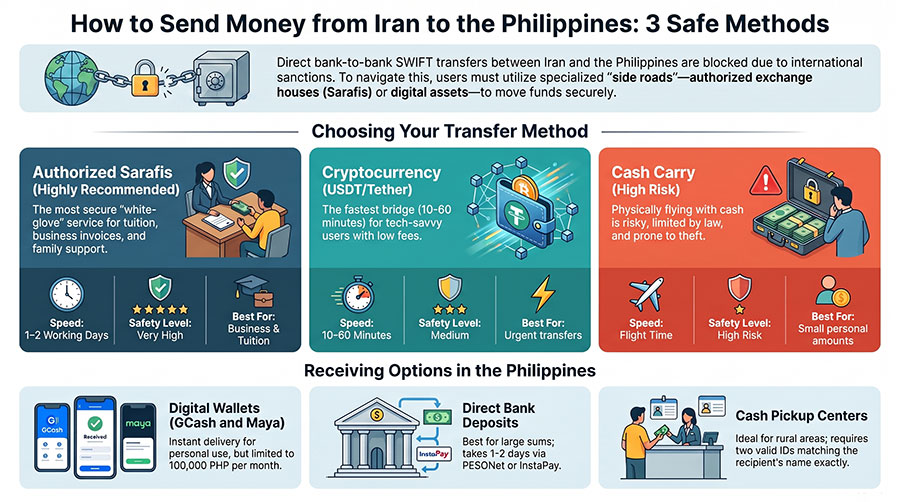
| Method | Speed | Safety Level | Receiving Option | Best For |
|---|---|---|---|---|
| Authorized Sarafi | 1–2 working days | Very High | Bank, GCash, Cash Pickup | Tuition, business, family support |
| Cryptocurrency (USDT) | 10–60 minutes | Medium | Local crypto exchange → Bank/Wallet | Urgent & tech-savvy users |
| Cash Carry | Flight time | High Risk | Physical cash | Small personal amounts |
| Direct Bank Transfer | ❌ Not possible | ❌ Blocked | — | ❌ Sanctions |
Sarafi Ahmadiani Services for Iran to Philippines Transfers
Sarfi Ahmadiani offers a specialized financial corridor that converts your Iranian Rials directly into Philippine Pesos or US Dollars, handling the entire compliance process so your funds arrive safely.
Finding a trustworthy partner is the most critical step in international finance. Sarafi Ahmadiani has positioned itself as a specialist for the Asian market. Unlike general exchanges that focus only on Dubai or Europe, this service understands the specific requirements of the Philippine banking system. This specialization is vital because Philippine banks are very strict about the source of funds.
When you use this service, you are essentially hiring a professional intermediary to manage the risk for you. You transfer Rials (IRR) to their account in Iran. They then use their liquidity in the Philippines or a third country to deposit Pesos (PHP) or Dollars (USD) into your beneficiary’s account. This “netting” process ensures that the transaction looks like a local transfer to the Philippine bank, preventing account freezes. For a broader overview of transferring money from Iran to multiple destinations, see how to send money from iran to other countries.
Key Service Benefits:
- Commercial Settlements:If you are a business importing electronics, fruits, or car parts from the Philippines, the Sarafi can handle large-volume invoices. They provide the necessary transaction receipts that help you balance your books.
- Tuition and Education:Many Iranians study dentistry, pharmacy, or medicine in cities like Cebu and Manila. The service guarantees tuition payments directly to the university’s bank account, ensuring you meet enrollment deadlines.
- Real-Time Exchange Rates:The rate is locked in the moment you confirm. You do not have to worry about the Rial devaluation during the transfer process.
- Dedicated Tracking:You are not left in the dark. The service provides updates from the moment they receive Rials until the Pesos land in the destination account.

Know More About “Sending Money to Philippines”
The process requires intermediaries because Iranian banks are disconnected from the global SWIFT network, meaning a direct bank-to-bank transfer is impossible without a bridge.
To navigate this successfully, you must understand why the blockage exists. It is not that money cannot move; it is that the “highway” (SWIFT) is closed to Iran. Therefore, we use “side roads.” The primary reason for the difficulty is the Financial Action Task Force (FATF) restrictions and international sanctions.
Philippine banks, such as BDO, BPI, and Metrobank, are highly regulated. They have strict Anti-Money Laundering (AML) software. If they see a transfer coming directly from a sanctioned source, they will reject it immediately. This is why you cannot simply walk into Bank Melli and ask to send money to Manila.
The solution is the “Hawala” system or modern digital brokerage. When users ask can Iran send money to Philippines effectively, they are usually directed to this system. It works on trust and credit. The money changer in Tehran takes your Rials. He calls his partner in Manila. The partner in Manila pays your receiver in Pesos. The two brokers settle their debt to each other later. This means no physical money crosses the border, making the transfer fast and immune to international wire blocks.

Best Methods to Transfer Money from Iran to Philippines
The three proven methods are using an Authorized Sarafi (for safety), Cryptocurrency (for speed), or Cash Carry (for small amounts, though risky). If your transfer is headed to South Asia, the process and risks are explained in how to send money from iran to india.
Each method serves a different purpose. Your choice should depend on whether you prioritize cost, speed, or security.

Method 1: Authorized Sarafis (Recommended)
This is the most reliable method for 95% of users. It effectively answers the question of can Iran send money to Philippines with a resounding “yes.”
Why it is the best: It is a “white-glove” service. You do not need to understand technology or banking laws. You simply pay Rials, and the Sarafi handles the conversion and deposit. If there is an error—for example, if the receiver’s bank account is dormant—the Sarafi has the local connections to fix the issue or retrieve the funds.
The Process: You contact the Sarafi, agree on a rate, transfer Rials via Satna or Paya (local Iranian banking systems), and provide the Philippines bank details. The money usually arrives within 1 to 2 working days.
Method 2: Cryptocurrency (USDT/Tether)
For the tech-savvy generation, this is the fastest bridge.
The Process:
1. Purchase USDT (Tether) on an Iranian exchange like Nobitex or Wallex using your Iranian bank card.
2. Withdraw the USDT to a personal wallet (like Trust Wallet) or directly to the receiver.
3. The receiver in the Philippines must have an account on a local crypto exchange like Coins.ph or PDAX.
4. The receiver sells the USDT for Pesos and withdraws it to their bank account or GCash.
The Risk: If you send the crypto to the wrong network (e.g., sending ERC20 to a TRC20 address), the money is lost forever. If you want to compare crypto versus exchange-house routes from another major corridor, review how to send money to iran from usa. Also, the receiver must be comfortable with technology.
Method 3: Cash Carry (Risky)
This involves physically flying with USD or Euros.
The Constraints: You are legally allowed to take out a limited amount of currency from Iran (often €5,000 via air). Upon entering the Philippines, you must declare any amount over $10,000 USD. If you fail to declare, customs agents can confiscate the money. This method is high-risk due to the potential for theft and loss during travel.
Receiving Options in the Philippines
Your beneficiary can receive funds via Mobile Wallets (GCash/Maya), Cash Pickup centers, or direct Bank Deposits, depending on their location and preference.
The Philippines has one of the most advanced “fintech” environments in Asia. When you arrange a transfer, you have multiple delivery options.

Digital Wallets (GCash and Maya)
This is the preferred method for personal remittances. GCash is a “Super App” in the Philippines.
- Speed:Transfers to GCash are usually instant once processed by the Sarafi.
- Limits:Be careful here. A standard GCash account has a wallet limit (often 100,000 PHP per month). If you send more than the limit, the transaction will fail. Always ask your receiver to check their current limit before you send.
- Convenience:The receiver gets an SMS and can immediately spend the money or cash out at a 7-Eleven.
Cash Pickup (Remittance Centers)
This is ideal for beneficiaries in rural areas (provinces) who may not have bank accounts.
- Providers:Cebuana Lhuillier, M Lhuillier, Palawan Express.
- Requirement:The receiver MUST have two valid IDs that match the name you provided exactly. If you write “Bob” but his ID says “Robert,” they will not release the money.
Bank Deposits
Best for large amounts, tuition, or business.
- Major Banks:BDO, BPI, Metrobank, UnionBank.
- Clearing Time:If sent before the daily cut-off, it might arrive the same day via “InstaPay.” larger amounts go via “PESONet,” which clears the next business day.
according to kimbocare these are Disadvantages of Bank deposits:
High Costs: Transfer fees and exchange rates can be particularly high. Additional costs may accumulate, especially for frequent or large transfers.
Slower Process: The processing of international transfers can take several business days, which is not ideal for urgent needs such as healthcare.
Complexity and Documentary Requirements: Sending money abroad through banks can require extensive documentation and administrative formalities, making the process sometimes tedious.
Step-by-Step Guide: How to Transfer Money Today
Follow this 5-step protocol: Verify ID, Check Rate, Deposit Rials, Provide Details, and Save the Receipt.
Here is a detailed walkthrough to ensure you do not make mistakes.
- Authentication (KYC):
Reputable Sarafis require “Know Your Customer” documents. You must send a photo of your National ID (Kart Melli) or Passport. This protects you. If a Sarafi does not ask for ID, be suspicious—they might be unlicensed. - Rate Check:
Currency rates fluctuate every hour. Contact the Sarafi and ask for the specific “Rial to Peso” rate. Do not just look at Google rates; the market rate includes the transfer costs. Confirm the exact amount of Rials you need to pay. - Deposit Rials:
Transfer the Rials to the Sarafi’s bank account.
Tip:For amounts under 100 million Tomans, you can often use mobile banking. For larger amounts, you may need to use the “Satna” interbank system, which settles during working hours. - Beneficiary Details:
Provide the following clearly in English:- Bank Name:(e.g., BDO Unibank)
- Account Name:(Must match their ID exactly)
- Account Number:(Double check this)
- Mobile Number:(Crucial for GCash)
- Receipt:
Once the transfer is initiated, you will receive a slip. Send this to your beneficiary. It usually contains a reference number they can use to track the funds.
Important Tips for Safe Transfers (Do’s and Don’ts)

Verify everything twice, avoid unlicensed dealers on social media, and pay attention to banking holidays to avoid delays.
DO: Check the “Spread”
The spread is the difference between the buy and sell price. Some agents claim “Zero Commission” but give you a very bad exchange rate. Always calculate: Amount of Rials divided by Amount of Pesos received. This gives you the real cost.
DON’T: Use Telegram Scammers
There are many anonymous groups offering rates that look too good to be true. These are often scams. Once you transfer the Rials, they delete their account. Always use a Sarafi with a physical office or a verifyable reputation like Ahmadiani.
DO: Watch for Holidays
The Philippines has many holidays (Christmas, Holy Week, Rizal Day). Banks are closed on these days. If you send money on a Friday in Iran, and it is a holiday weekend in the Philippines, the money might not reflect until Tuesday. Plan ahead.
DON’T: Ignore Limits
If sending to a student, ensure their student bank account can accept international transfers. Some student accounts have caps.
Comparison of Transfer Methods
Sarafis offer the best balance of safety and ease, while Crypto is fastest but requires technical skill.
| Method | Speed | Risk | Cost | Best User |
| Authorized Sarafi | 1-2 Days | Low | Moderate | Families, Traders, Students |
| Cryptocurrency | 10-30 Mins | Medium | Low | Tech-savvy individuals |
| Cash Carry | Flight Time | High | Variable | Tourists |
Frequently Asked Questions (FAQ)
Common questions cover bank limitations, timeframes, and specific tuition payment concerns.
Can I send money directly from Bank Melli to BDO?
No. Due to sanctions, there is no direct SWIFT connection between Iranian banks and Philippine banks. You must use an intermediary service.
How long does the transfer take?
Via a Sarafi, it typically takes 24 hours (1 working day). If sent early in the morning, it can sometimes arrive the same day. Crypto is almost instant.
Is there a limit on how much I can send?
Sarafis can handle large commercial amounts (e.g., for imports). However, for personal transfers to mobile wallets like GCash, the limit is usually 100,000 Pesos per month. Bank accounts generally have much higher limits.
Can Iran send money to Philippines for university tuition?
Yes. This is a standard service. You provide the university’s invoice, and the Sarafi deposits the exact amount into the school’s account.
What if I make a mistake in the account number?
If you use a Sarafi, notify them immediately. If the account number does not exist, the money will bounce back (this takes a few days). If the account number belongs to a wrong person, it is very difficult to retrieve. Accuracy is key.
Conclusion
Sending funds across borders, especially from Iran, can seem daunting at first. However, the answer to “can Iran send money to Philippines” is a positive one. The financial bridge is active and secure if you use the correct channels. You do not need to rely on risky cash carrying or complex legal loopholes.
By utilizing a trusted, specialized intermediary like Sarafi Ahmadiani, you gain access to a system that is designed to handle these specific challenges. Whether you are supporting a student in Manila, paying for a shipment of goods, or helping family, the process is straightforward: verify, deposit, and track. Move away from the worry of sanctions and embrace the efficiency of modern exchange services.