
 فارسی
فارسی
 english

International financial transfers are complex, especially when sanctions and banking restrictions are involved. If you need to send money from Iran to UK, you are likely facing significant hurdles, from blocked access to global banking networks to the fear of having your UK account frozen. This is not a simple task, but it is a manageable one if you follow the correct legal protocols. This article provides a complete, technical, and practical roadmap for students, investors, and families. If you are dealing with inbound transfers instead, you may also want to review send money to iran from uk. You will learn how to navigate compliance checks, minimize fees, and choose the safest transfer method available in 2025.
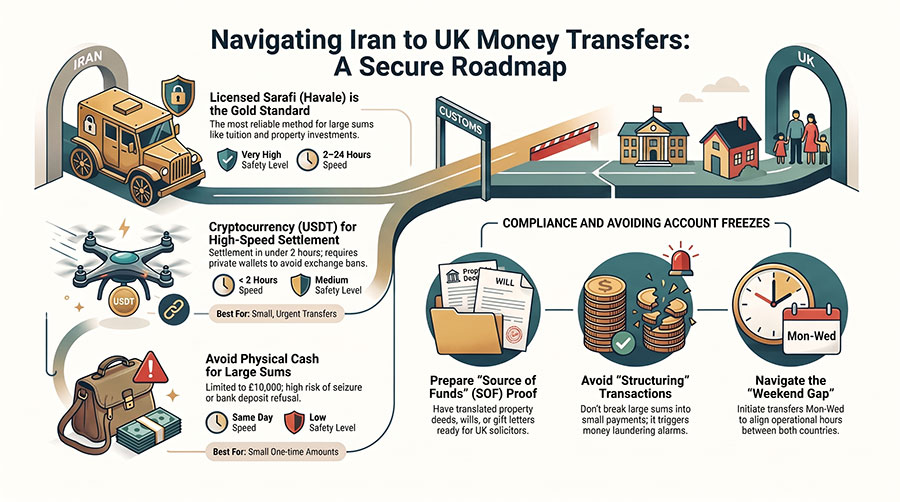
| Method | Speed | Safety Level | Documentation | Best For |
|---|---|---|---|---|
| Licensed Sarafi (Havale) | 2–24 hours | Very High | Official receipt, exchange proof | Tuition, family support, property funds |
| Cryptocurrency (USDT) | < 2 hours | Medium | Blockchain record only | Small & urgent transfers |
| Physical Cash | Same day (travel-based) | Low | Customs declaration only | Small one-time amounts |
| Direct Bank Transfer | ❌ Not possible | Very High Risk | — | ❌ Blocked by sanctions |
Send Money from Iran to UK (Sarafi Ahmadiani Services)
Sarafi Ahmadiani offers a specialized, compliance-focused service designed to securely convert Iranian Rials (IRR) to British Pounds (GBP) without triggering banking security alarms.
When you attempt to send money from Iran to UK, the most critical factor is the reliability of the intermediary. Sarafi Ahmadiani is not just a currency exchange; we are a financial logistics partner. We understand that the UK banking system is highly sensitive to funds originating from the Middle East. Therefore, our service is built around transparency and security.
We facilitate transfers ranging from small monthly stipends for university students to substantial capital movements for property investments. Our distinct advantage lies in our network of regulated partners within the UK. When we deposit funds into your British bank account, the transaction appears legitimate and clean, significantly reducing the risk of an audit or account freeze.
Our Service Guarantees:
- Instant Price Verification: Currency markets are volatile. We provide real-time exchange rates so you know the exact value of your capital.
- Zero Hidden Costs: We operate with a single, all-inclusive rate. There are no surprise service fees added after the transaction is agreed upon.
- Compliance First: We ensure that the source of the transfer in the UK is safe, protecting your long-term banking relationship.
If you need to transfer funds immediately, contact our support team to lock in today’s Pound Sterling rate.

Know More About Sending Money from Iran to UK
Before initiating any transaction, it is vital to understand the structural problems preventing direct bank transfers between these two nations.
The core issue is the disconnection of Iranian banks from the SWIFT network. SWIFT is the messaging system that global banks use to communicate. Without it, a bank in Tehran cannot electronically signal a bank in London to move money. Furthermore, strict international sanctions mean that UK banks—such as HSBC, Barclays, and NatWest—employ rigorous automated filters. These algorithms flag any transaction that seems to have a link to sanctioned entities or unclear origins.
This creates a stressful environment for Iranians abroad. You might have legitimate funds from selling an apartment or an inheritance, yet you feel treated like a suspect. This is a common experience. However, legitimate pathways exist. The “Havale” system (remittance), cryptocurrency, and physical cash carriage are the primary methods used to bridge this gap. This guide explores how to utilize these methods to send money from Iran to UK while staying fully compliant with UK Anti-Money Laundering (AML) regulations.

Best Methods to Transfer Money from Iran to England
To successfully move your capital, you must choose a method that aligns with your volume of funds and your comfort with technology. Here are the primary avenues available.
- Sarafi (Exchange Shops): The standard, most reliable method for amounts over £1,000.
- Cryptocurrency (USDT/Tether): A high-speed option for tech-savvy users requiring instant settlement.
- Online Payment Intermediaries: Using third-party services to bridge platforms like PayPal (complex and often expensive).
- Cash: Carrying physical notes across the border (strictly limited).
For users transferring funds to multiple destinations, a broader overview is available in how to send money from iran to other countries.

Transfer via Trusted Exchange Shops (Sarafi)
The Havale system remains the safest and most efficient way to send money from Iran to UK. It operates on a debt-settlement basis rather than physical money movement.
In this process, you deposit Rials into the Sarafi’s account in Iran. Simultaneously, the Sarafi instructs their partner in London to deposit the equivalent amount of Pounds into your UK bank account. The key detail here is the “Partner.” If the partner is a regulated Money Service Business (MSB) in the UK, the transfer is smooth. If the partner is an unknown individual transferring from a personal account, the risk is high.
At Sarafi Ahmadiani, we prioritize the safety of the “sender” identity. We ensure the funds entering your account do not raise red flags. This method is ideal for paying tuition, buying property, or transferring living expenses because it provides a clear receipt of exchange.

Transfer via Cryptocurrency (Tether/USDT)
For those comfortable with digital assets, cryptocurrency offers a way to send money from Iran to UK that bypasses the traditional banking delays entirely. If your destination is South Asia, you can also compare compliance risks in how to send money from iran to india.
The currency of choice is Tether (USDT), a stablecoin pegged to the US Dollar. The process involves three distinct steps:
- Purchase in Iran:You register with an Iranian crypto exchange (such as Nobitex or Wallex) and purchase USDT using your local bank card.
- Intermediate Transfer:You must withdraw the USDT to a private, non-custodial wallet (like Trust Wallet or MetaMask). Warning: Never send directly from an Iranian exchange to a UK exchange like Coinbase. This will result in an immediate ban.
- Sale in UK:From your private wallet, you send the crypto to a UK-licensed exchange (like Kraken, Binance, or Coinbase), sell it for GBP, and withdraw to your bank.
This method is incredibly fast—often taking less than an hour. However, UK exchanges require strict “Know Your Customer” (KYC) verification. You must provide a passport and proof of address. Additionally, banks sometimes view proceeds from crypto exchanges with suspicion if the volume is very high.
Carrying Cash by Passenger
Physical cash is a traditional method, but it is fraught with legal peril and practical inconvenience.
The UK customs allowance permits you to bring up to €10,000 (or the equivalent in Pounds/Dollars) per person without declaration. If you carry more, you must complete a declaration form (Form C9011) at the airport. Failure to do so can lead to the seizure of the entire amount by the UK Border Force.
Even if you declare the cash legally, the real problem begins when you try to deposit it. UK high street banks are closing branches and removing cash counters. If you walk in with £15,000 in cash, the teller is required to ask for the Source of Funds. Without a solid paper trail proving where that cash came from (which is hard to prove with cash carried in a bag), they may refuse the deposit. We generally advise against this method for large sums.
according to uk gov:
You must declare cash of £10,000 or more to UK customs if you’re carrying it between Great Britain (England, Scotland and Wales) and a country outside the UK.
If you’re travelling as a family or group with £10,000 or more in total (even if individuals are carrying less than that) you still need to make a declaration.
If you’re travelling to Northern Ireland and carrying €10,000 or more (or equivalent) you must follow the rules for taking cash into Northern Ireland.
The earliest you can make a declaration is 72 hours before you plan to travel.
Important Rules for Preventing Bank Account Blocks in UK
The most devastating outcome of a transfer is having your UK bank account frozen. This usually happens because of a lack of clear documentation regarding the Source of Funds (SOF).
UK banks operate under strict regulations like the Proceeds of Crime Act. If a transaction deviates from your normal spending pattern, for example, a student account suddenly receiving £50,000, the system freezes it automatically. To send money from Iran to UK safely, you must be proactive, not reactive.

Document Checklist (Prepare Before Transfer):
- Property Sale Deeds: If the money comes from real estate, you need the official contract, legally translated into English.
- Inheritance Wills: Official probate documents if the funds are inherited.
- Bank Statements: 6 to 12 months of statements from your Iranian bank showing salary accumulation or savings history.
- Gift Letter: If a family member is supporting you, they must sign a formal letter stating the money is a gift, not a loan, and verifying their relationship to you.
Furthermore, avoid “structuring” or “smurfing.” This is the illegal practice of breaking a large transfer into many small ones (e.g., ten transfers of £900) to avoid detection. Banking AI is smart enough to detect this pattern immediately and will flag it as money laundering. It is safer to send one large, transparent transaction with proper documentation than many small, suspicious ones.
Transfer Fees and Exchange Rates (IRR to GBP)
Understanding the true cost of your transfer is essential for financial planning. The “cost” is a combination of the exchange rate difference and the service fee.
When you look to send money from Iran to UK, you will see different rates advertised. Some exchanges offer a rate that seems incredibly cheap (close to the Google market rate) but then add a 3% to 5% commission at the end. Others advertise “Zero Commission” but offer a terrible exchange rate, effectively hiding their profit in the spread.
To calculate the real cost, ignore the marketing claims. Ask one simple question: “If I pay you 1 billion Tomans right now, what is the exact net amount of Pounds that will land in my account?” Compare this final GBP figure across different providers. At Sarafi Ahmadiani, we value transparency. The rate we quote is the final execution rate, ensuring you can calculate your budget down to the last penny without fear of hidden deductions.
How Long Does a Money Transfer Take?
Timing is critical, especially for tuition deadlines or property completion dates. The speed varies significantly by method.
- Cryptocurrency: 30 minutes to 2 hours. This is the fastest option but requires you to handle the technical execution yourself.
- Sarafi (Internal Transfer): 2 to 24 hours. If the Sarafi has liquid funds available in the UK, the transfer is often same-day.
- Sarafi (Bank Deposit): 1 to 3 Working Days. This utilizes the UK banking clearing networks (Faster Payments, BACS, or CHAPS).

The “Weekend Gap” Phenomenon:
You must account for the mismatch in weekends. Iran’s banking system is closed on Thursdays and Fridays. The UK banking system is closed on Saturdays and Sundays. This creates a potential four-day delay if you time it poorly. For example, a transfer initiated on Thursday in Iran might not be processed in the UK until Monday. The optimal time to send money from Iran to UK is on a Monday, Tuesday, or Wednesday. This alignment ensures that banks in both countries are operational, facilitating a smoother and faster settlement.
Buying Property in UK with Funds from Iran
Real estate transactions involve the highest level of scrutiny. If you plan to buy a house, you cannot simply transfer cash to the seller.
In the UK, property purchases are handled by Solicitors (lawyers). Solicitors are even more strict than banks regarding Anti-Money Laundering (AML) checks. They are personally liable if they facilitate a purchase with dirty money. Therefore, they will not accept funds directly from your bank account unless you can prove the entire history of those funds.
If you intend to send money from Iran to UK for a property deposit, you must inform your Sarafi. We can help structure the transfer to provide the “traceability” that solicitors require. We can often provide a specific transaction receipt that verifies the exchange of currency. Crucially, solicitors usually reject “gifted deposits” if they cannot verify the identity of the donor. Hence, it is often better to transfer the funds to your own UK account first, let them “mature” for a few months, and then transfer them to the solicitor.
Paying UK University Tuition Fees from Iran
Iranian students in the UK often face anxiety regarding tuition payments. A blocked account during exam season is a nightmare scenario.
The most effective strategy to send money from Iran to UK for education is to bypass your personal bank account entirely. Sarafi Ahmadiani can execute a “Third Party Payment” directly to the University. You provide us with the University’s official bank details, your Student ID number, and the invoice reference.
This method has three distinct advantages. First, it removes the risk of your personal account being flagged for a sudden large inflow of cash. Second, Universities are large institutions accustomed to receiving international transfers and rarely reject them. Third, it provides immediate proof of payment to the university finance office, ensuring your enrollment is secure. This is the recommended path for all tuition and accommodation fees.
Why Choose Sarafi Ahmadiani for UK Transfers?
In a market filled with uncertainty, Sarafi Ahmadiani stands out by offering reliability, technical expertise, and genuine support.
We understand the nuances of the UK banking sector. We know which banks (like Monzo, Revolut, and Starling) are hostile to international transfers and which High Street banks (like Santander, Barclays, and Lloyds) are more amenable if proper documentation is provided. We guide our clients not just on the exchange rate, but on the banking process itself.
Our support team is available to assist you, bridging the time zone gap. We offer a level of personalized service that anonymous apps cannot match. Whether you need to send money from Iran to UK for a family emergency or a long-term investment, we treat your capital with the security it deserves.
Conclusion
Transferring wealth across borders in the current geopolitical climate requires caution, knowledge, and the right partners. It is not impossible, but it demands a strategic approach. To safely send money from Iran to UK, you should avoid informal, unverified transfers and instead rely on professional exchange services that prioritize compliance. By preparing your Source of Funds documentation in advance, choosing the right transfer method for your specific needs, and avoiding risky neo-banks for large sums, you can protect your financial assets. Do not leave your hard-earned money to chance. Contact Sarafi Ahmadiani today for a consultation and the most competitive exchange rates.
FAQ
Is it legal to send money from Iran to UK despite sanctions?
Yes. Personal transfers for education, living expenses, family support, or investments are legal as long as they are processed through compliant channels and meet UK AML regulations.
Why do UK banks freeze accounts after receiving money from Iran?
UK banks automatically freeze accounts when they detect unusual activity or unclear sources of funds. Proper documentation and using regulated intermediaries prevents this issue.
Is using Sarafi safer than cryptocurrency?
For large or regular transfers, yes. Sarafi transfers provide clearer transaction records and are more accepted by UK banks and solicitors compared to crypto-based inflows.
Can I send money directly to a UK university from Iran?
Yes. Direct third-party payments to universities are one of the safest options and help avoid personal bank account scrutiny.
What documents should I prepare before transferring money?
Property sale contracts, inheritance papers, bank statements, or a formal gift letter translated into English are essential to prove source of funds.